
The fastest way to scale marketing capacity without adding headcount is to work with vetted freelancers through a marketplace, agency, staffing firm, or managed talent platform. The right choice depends on how much work you need to get done, how much time your team has to manage outside talent, and how much flexibility you need.
I’ve spent more than 15 years building and managing communities of freelance experts, first at uTest (now Applause) and, since 2017, at nDash. During that time, I’ve seen marketing teams run into the same problem again and again. Workloads keep growing, hiring budgets don’t keep pace, and the people already on the team have more work than they can reasonably handle.
Hiring another full-time employee isn’t always the best answer, particularly when workloads fluctuate or projects require specialized expertise. But bringing in outside help raises its own questions. This guide answers those questions and will help you compare options. I’ll also be candid about where nDash fits, where another approach might make more sense, and what to look for before choosing a provider.
For context, nDash is a freelance marketing talent platform that connects brands and agencies with vetted freelance talent and other marketing specialists. We offer both self-managed and fully managed plans, depending on how much involvement your team wants.
Key takeaways:
- Scale marketing capacity without adding headcount through freelance marketplaces, agencies, staffing firms, or managed talent platforms.
- The best option depends on your workload, available management time, and contract flexibility.
- Flexible talent lets you adjust spending as needs change, rather than commit to another full-time salary and benefits package.
- Even without a long-term contract, freelancers need time to understand your brand, audience, and expectations.
- Compare providers based on the total cost of completed work, including internal management and revision time, rather than hourly rates alone.
What does it mean to scale marketing capacity?
Scaling marketing capacity means increasing the amount of work your team can reliably deliver without a corresponding increase in full-time employees. Headcount and marketing capacity are related, but they aren’t interchangeable. Adding another employee increases the number of people on your team, whereas increasing marketing capacity gives you more ways to get work done. Depending on your needs, that could involve outside specialists, better processes, new tools, or some combination of the three.
How do you know when your marketing team needs more help?
A growing backlog is an obvious sign, but the problem often shows up elsewhere first. For example, campaign timelines may start slipping. Or experienced marketers spend their days on production tasks, or projects get assigned to whoever has time rather than whoever has the right expertise.
Workload patterns are also important. Your team might struggle to keep up during product launches, trade shows, and busy campaign periods, then have considerably less work a few months later. Hiring someone full-time for those peaks doesn’t necessarily make financial sense.
There are three primary ways to increase marketing output:
- Flexible talent: Bring in experienced freelancers to handle production, fill skill gaps, or support temporary projects.
- Better processes: Improve briefs, approvals, and project workflows to boost efficiency.
- Marketing tools: Use technology to reduce repetitive administrative work and help employees focus on work that requires their expertise.
Each approach can help, although this guide focuses primarily on finding and managing flexible marketing talent.
Why scale marketing capacity without adding headcount?
Hiring full-time employees brings ongoing expenses beyond salaries. Flexible marketing talent gives companies another option, particularly when workloads fluctuate or they need specialized skills for a limited period.
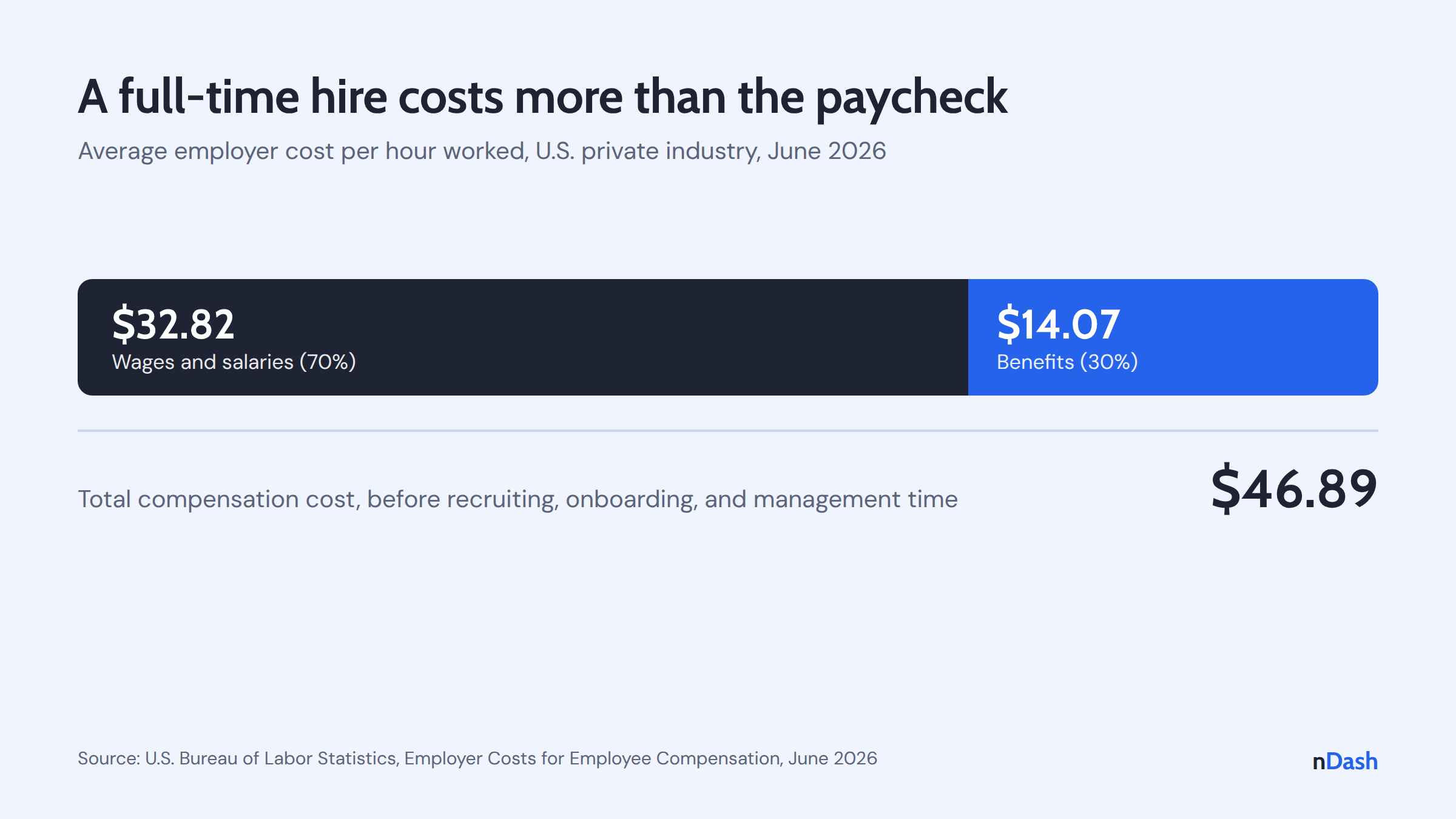
Data shows that employer compensation costs for private industry workers averaged $46.89 per hour in June 2026. Benefits accounted for 30% of that total, with wages and salaries making up the remaining 70%. Those figures don’t represent marketing positions, specifically. They also don’t include expenses for recruiting, equipping, onboarding, and employee management.
How does flexible talent change marketing costs?
A full-time employee receives compensation regardless of whether the company has enough work to occupy that person’s schedule. Freelancers generally work under project-based or time-based agreements so that companies can buy services based on immediate needs.
For example, your team might produce blogs regularly but need additional design and SEO support only during quarterly campaigns. The problem is that hiring two permanent specialists could leave parts of their schedules unfilled. Bringing in freelancers for those projects lets the company access both skill sets without creating two ongoing positions.
The potential savings depend on project rates, work volume, and how much management the arrangement requires. Remember that flexible talent isn’t automatically cheaper, especially when the work is substantial and consistent year-round.
Experienced independent professionals are also well established in the labor market. Independent workers now make up 22% of the full-time US workforce, more than double their 10% share in 2019. That includes independent contractors, consultants, and freelancers who have built lasting careers outside traditional employment.
Although that figure isn’t specific to marketers, it illustrates how established independent work has become. Companies can find experienced professionals outside traditional employment arrangements rather than treating freelance hiring as a temporary last resort.
What are some ways to scale marketing capacity?
Common options for scaling marketing capacity without hiring employees are freelance marketplaces, curated or managed talent platforms, staffing firms, and traditional marketing agencies. Each offers a different balance of talent selection, project management, cost, and contractual flexibility.
The right approach depends partly on whether your team needs additional people to execute existing plans or an outside provider to take responsibility for the work itself.
|
Model |
Best for |
Typical terms |
Who vets talent? |
Who manages the work? |
Cost structure |
|
Freelance marketplace, such as Upwork or Fiverr |
Teams comfortable hiring and managing freelancers |
Often project-based |
Primarily the buyer |
Your team |
Freelancer rates plus fees |
|
Curated or managed talent platform, such as nDash |
Specialized talent with optional project management |
Depends on service tier |
Platform |
Your team or provider |
Membership, project, or managed-service fees |
|
Staffing firm, such as Aquent |
Filling temporary roles or extending an existing team |
Often assignment-based |
Staffing firm |
Generally your team |
Hourly or placement-related fees |
|
Traditional marketing agency |
Outsourcing campaign strategy and execution |
Often retainers or statements of work |
Agency |
Agency |
Retainers or project fees |
Comparison reflects general service models. Individual provider terms vary and should be reviewed before purchase.
How do these marketing service models differ?
- Freelance marketplaces offer access to large pools of independent professionals, often across a wide range of budgets. Buyers typically review profiles, assess qualifications, create assignments, and oversee delivery. They’re a good option when you already know how to manage freelancers and have enough time to do it.
- Curated and managed talent platforms narrow the search by screening professionals and helping companies find suitable matches. Some also handle production management. With nDash, for example, brands can work directly with freelancers or use a managed service that handles day-to-day execution.
- Staffing firms focus on supplying professionals who work within a company’s existing operations. This can be useful when you need someone in a particular role for several months, but you generally remain responsible for assigning and supervising their work.
- Traditional agencies offer broader ownership of marketing programs, often including planning, creative development, execution, and reporting. They’re worth considering when you want to delegate an entire function rather than bring specialists into an existing program.
Before comparing prices, decide how much responsibility you want the provider to take. Two services can offer similar talent but require very different amounts of your team’s time.
Who offers extra marketing help without a long-term contract?
Freelance marketplaces and curated talent platforms generally offer more opportunities to purchase marketing services without a long-term commitment. Agencies and staffing firms may require minimum engagement periods, retainers, or cancellation notice.
Contract flexibility is worth a close look, too, because a service advertised as flexible may still require several months of payments or limit how quickly you can reduce spending.
Marketplace arrangements are often project-based, allowing you to engage someone for a single assignment. Curated networks may offer individual projects, trial engagements, or monthly plans. Agency and staffing agreements frequently have more formal terms, especially when the provider reserves people specifically for your account.
At nDash, self-managed options allow brands to work with freelancers without committing to an ongoing managed engagement. Our current published terms specify an initial three-month commitment for managed services, with flexibility to adjust the workload within the arrangement.
Why should you plan for ramp time even with a flexible contract?
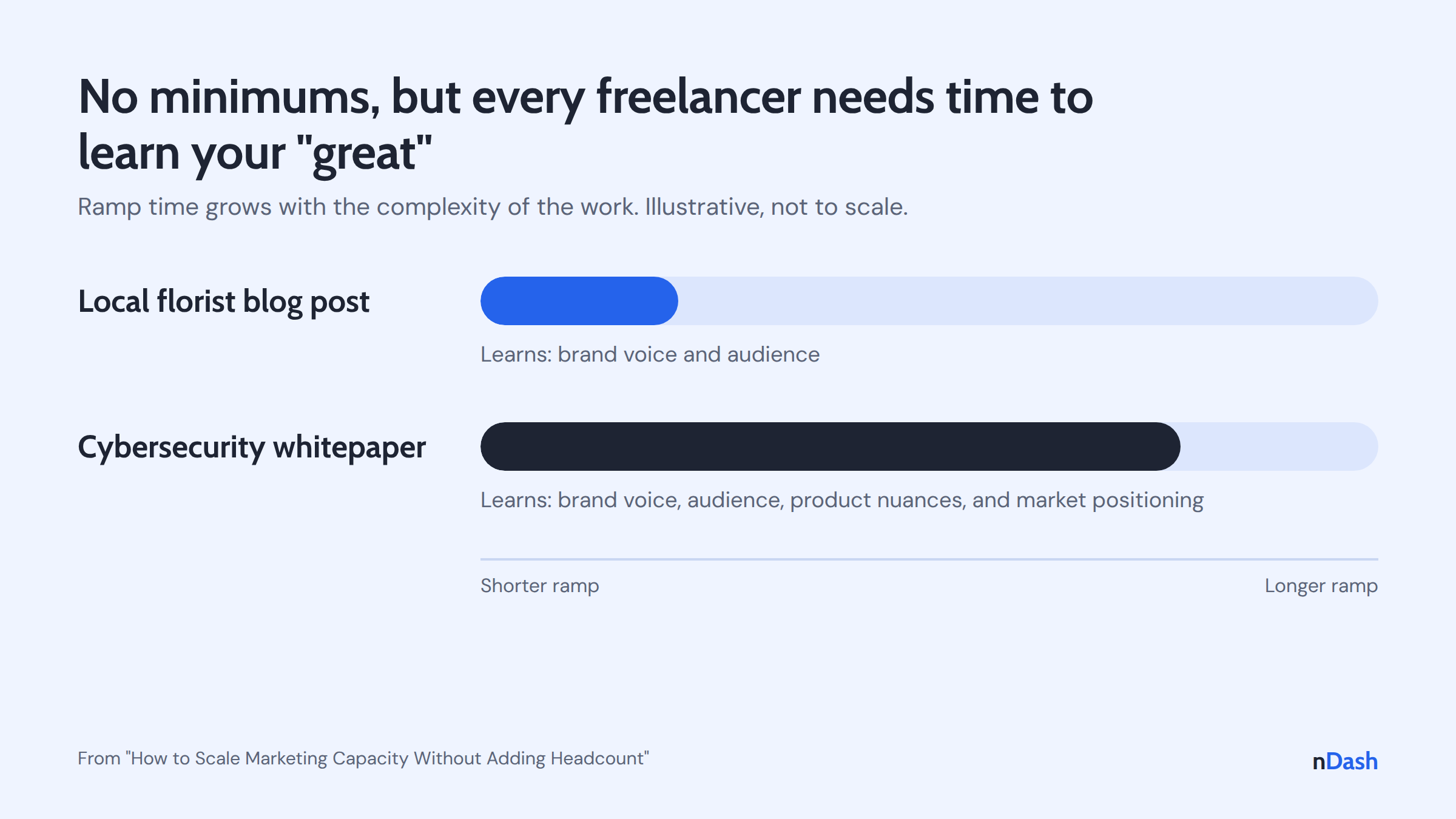
I’ve always given brands one piece of advice about freelance relationships. No long-term commitment doesn’t mean someone can immediately produce excellent work without learning anything about your business. Freelancers are human, and they need time to understand what great work looks like for your brand. How long it takes depends on the complexity of the assignment.
A blog post for a local florist might come together quickly. A technical cybersecurity whitepaper is different. The writer needs to understand the product, the audience, the terminology, and how the company positions itself against competitors.
Before starting an engagement, provide relevant samples, brand guidelines, background material, and access to someone who can answer questions. Building that learning period into your schedule gives freelancers a better chance of meeting expectations and makes the relationship more productive over time.
What marketing services let me adjust spending month to month?
Project-based services and monthly plans without extended minimum terms offer the most flexibility for adjusting marketing spending. They let companies increase production during busy periods and reduce commitments when demand declines. However, billing frequency alone doesn’t determine flexibility. A service can send monthly invoices while requiring a six-month agreement, minimum monthly spending, or advance notice to cancel.
How does flexible marketing spending work in practice?
Orange Marketing, a HubSpot Diamond Agency Partner, is a good example. Their Content Lead, Monica Caraway, explained, “Our needs dramatically fluctuate. For example, a recent month was heavy for us, with 18 pieces of content in progress, but the two months prior weren’t. We aren’t comfortable being locked into a contract where we’re forced to plan and pay for an ongoing commitment.”
Before signing with any provider, ask three questions:
- Is there a minimum engagement term? Find out whether you’re committing to individual projects, monthly services, or a longer agreement.
- What happens when you cancel or downgrade? Check for notice requirements, termination fees, and restrictions on reducing services.
- What happens to unused hours or credits? Confirm whether unused services roll into the next month, expire, or remain payable.
A provider offering slightly higher project rates may still be the better financial choice when it lets you avoid paying for services you don’t need.
Which freelance marketing platforms have the best reviews for reliability?
Reliable freelance marketing platforms offer more than access to qualified professionals. They also help companies address issues when assignments go wrong, provide support when needed, and show experience working with businesses with similar requirements. Verified review platforms such as G2 are a useful starting point. However, an overall rating won’t tell you everything you need to know as a buyer.
What should you look for in freelance platform reviews?
Before choosing a provider, evaluate four areas that affect whether projects get completed successfully.
- Vetting: Find out how freelancers are screened and whether additional checks are available for specialized or sensitive projects.
- Fit: Ask what happens when a freelancer’s experience, communication style, or work doesn’t meet your expectations.
- Human support: Determine whether someone familiar with the talent can help resolve problems or whether you’re responsible for finding a replacement.
- Relevant experience: Look for case studies and reviews from businesses in similar industries, with similar workloads and project requirements.
At nDash, vetting can range from reviewing portfolios and professional experience to more extensive screening, including background checks when needed. Additional screening can involve extra costs. I’ve also learned that a freelancer can look excellent on paper and still be the wrong match for a particular company. Sometimes the issue is technical expertise. Other times, it’s communication, workflow preferences, or simply how someone approaches the assignment. When that happens, we use what we’ve learned to find someone better suited to the work. Our team has worked directly with freelancers from a wide range of marketing backgrounds, and that experience helps us make more informed matches.
As of September 2026, nDash had a 4.8 out of 5 rating on G2, based on 36 reviews. Those reviews include feedback from both brands and freelancers, so buyers should review the ones most relevant to their needs. A high rating is encouraging, but what matters more is whether a provider can consistently supply suitable talent and help your team recover quickly when an assignment doesn’t go as planned.
Which companies actually deliver quality content at high volumes?
Companies that consistently produce high volumes of quality content combine access to experienced specialists with a production process that supports them. The provider needs to match the right people to each assignment, and the client needs to communicate its expectations before production begins. Several nDash customer stories illustrate how companies have increased output while addressing different production challenges.
Bitdefender accelerated campaign production by approximately 50%
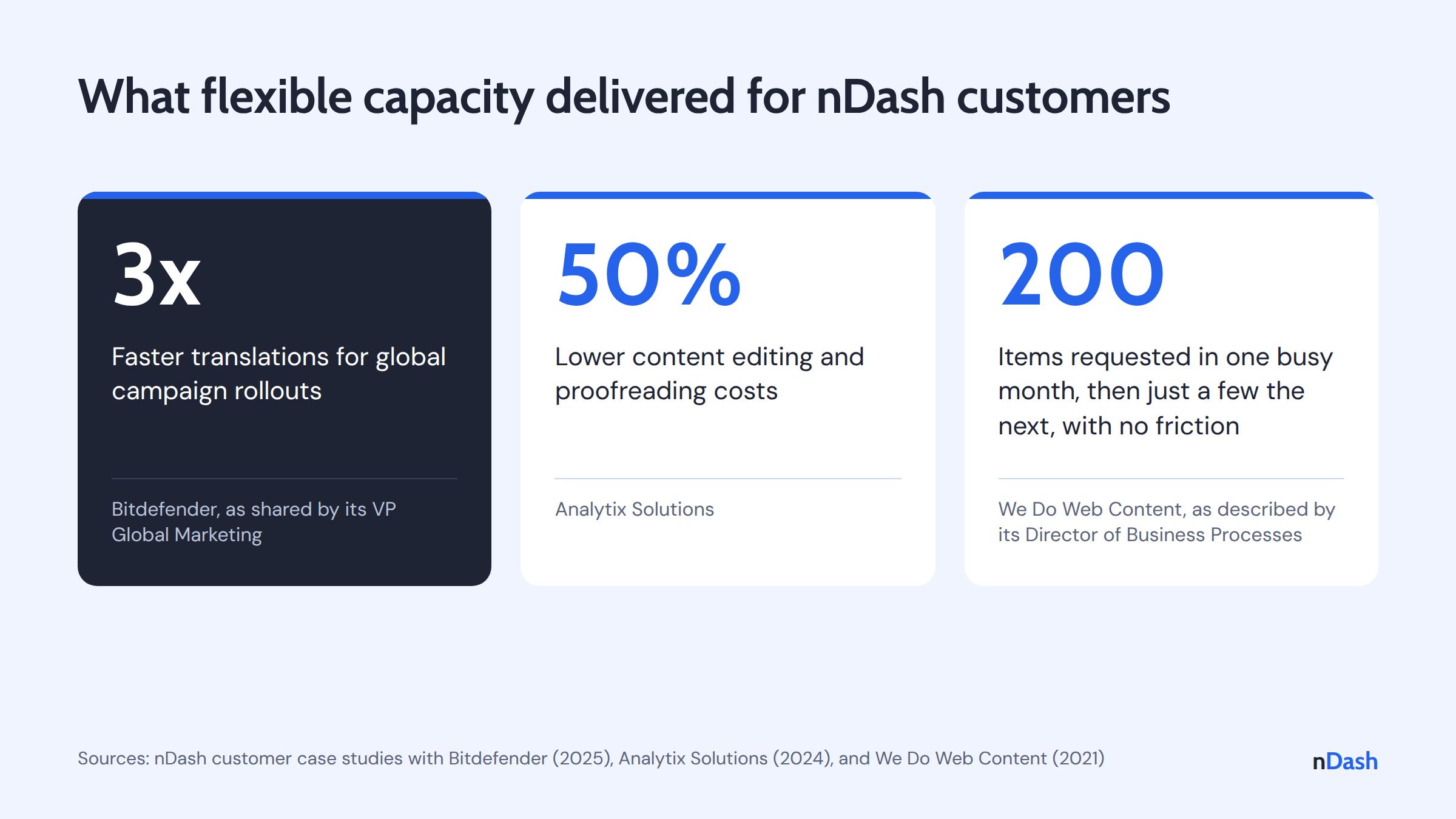
Cybersecurity company Bitdefender needed content supporting global campaigns, including technical whitepapers, web copy, video scripts, and outbound sequences. Subject-matter experts had previously bottlenecked production. Working with nDash allowed the company to bring in writers who understood the technical subject matter and could develop material across multiple formats. Clint Poole, former VP of Global Marketing for Bitdefender’s Business Solutions Group, estimated that campaigns reached the market approximately 50% faster than before. The Bitdefender customer story illustrates the value of matching specialized writers to technical marketing assignments rather than relying exclusively on internal experts to develop every asset.
Analytix Solutions reduced editing and proofreading costs by 50%
Producing a first draft is only one part of content creation. Editing, proofreading, and revisions can consume considerable internal time, particularly when writers aren’t familiar with a company’s expectations. Analytix Solutions worked with nDash to improve its production process and reported a 50% reduction in editing and proofreading costs. The improvement came from receiving content that required less internal correction. Its team could spend less time repairing drafts and more time on other responsibilities. The Analytix customer results show why evaluating content quality solely by freelancer rates can be misleading. A more experienced writer may cost more per assignment but save money across the full production process.
We Do Web Content added 15 writers to support changing demand
We Do Web Content faced a different challenge. Its workload could change dramatically, creating a need for substantial content production in some months and considerably less in others. The company brought 15 freelance writers into its partnership with nDash. During busy periods, it could engage the entire team. During slower periods, it worked with fewer writers. Aaron Fennell, Director of Business Processes and Innovation, described the ability to request 200 content items one month and only a few the next without creating problems for the partnership. The We Do Web Content story shows how flexible access to multiple writers can help an agency manage unpredictable production requirements.
Epsilon built its content resource center with specialized writers
Epsilon began treating content marketing as a dedicated discipline in 2018, creating a need for material across industries and product categories. Its internal team needed content that addressed the challenges facing different audiences, including retail and financial services. That required writers who could work within a structured strategy while bringing industry-specific knowledge. Working with nDash helped Epsilon develop content for its Resource Center while the company’s broader content marketing program took shape. Detailed briefs helped writers understand each assignment, and the ability to work with freelancers gave the company flexibility as its content strategy developed.
These examples involve different organizations and business goals, but they share an important feature. The companies had access to people whose expertise matched the work, supported by a process for assigning projects and reviewing results.
What providers handle extra client work for small marketing agencies?
Small marketing agencies can use freelance marketplaces, curated talent platforms, or managed services to handle additional client work. Providers supporting white-label delivery, nondisclosure agreements, and specialized marketing disciplines are particularly useful when agencies need help without involving another visible brand in the client relationship.
Agency workloads rarely increase in a neat, predictable pattern. One client may request an additional campaign with little notice, while another may pause a project. New business can also require expertise outside the agency’s usual services. Hiring employees for every possible client requirement would be expensive. Maintaining access to outside specialists gives agencies another way to serve those accounts.
What should agencies expect from a white-label marketing partner?
Confidentiality and client ownership are often as important as the work itself. Before selecting a provider, ask whether it can communicate under your agency’s name, follow your approval processes, and manage the legal requirements associated with client assignments. We support agencies that need exactly this kind of arrangement. Some ask our team to use an agency email address so their clients never encounter nDash branding. We can also manage freelancer NDAs under the agreement and follow the procurement process their team requires.
Industry knowledge is another factor. For example, an agency supporting healthcare, manufacturing, and B2B software clients needs more than a group of generalist content creators. It needs specialists who can adapt to different technical requirements, audiences, and deliverable formats. We saw that with Orange Marketing. Its team needed qualified writers across industries and reported spending at least 20% less time on editing, revisions, and project management through its partnership with nDash.
Before selecting a white-label partner, consider the types of work your clients regularly request and the additional services you want to offer. A provider with specialists across several marketing disciplines may help you pursue opportunities you would otherwise have to decline.
Who can manage freelance marketing projects for our overstretched team?
Managed talent platforms and marketing agencies can oversee freelance projects when your internal team doesn’t have time to manage the work. A managed talent platform generally gives you access to individual specialists while overseeing their assignments. An agency is often better suited to owning a complete marketing program. Consider what happens after you engage a freelancer. Someone needs to prepare the brief, establish deadlines, answer questions, review work, request revisions, and approve final delivery. If those responsibilities fall to an employee who is already overloaded, bringing in outside help may simply replace production work with additional project management.
How does nDash support freelance project management?
nDash offers different levels of involvement based on how much control and support your team needs.
- Self-managed services are intended for marketers who want to maintain direct responsibility for assigning work, communicating with freelancers, and reviewing deliverables. nDash supports talent sourcing, matching, and issues that arise during the relationship.
- Managed services provide a more involved approach. Our team handles the day-to-day project work, including briefs, assignments, deadlines, revisions, and quality review. Your team remains involved in setting priorities and approving deliverables without overseeing every production step.
I’ve found that some marketing managers genuinely enjoy building relationships with freelancers and working closely with them. Others would prefer to spend their time planning campaigns, working with stakeholders, and measuring performance. Both approaches can be effective. The key is to choose a service that reflects how your team actually wants to work, rather than paying for management you don’t need or taking on responsibilities you don’t have time to fulfill.
What’s the best service for expanding marketing output without hiring employees?
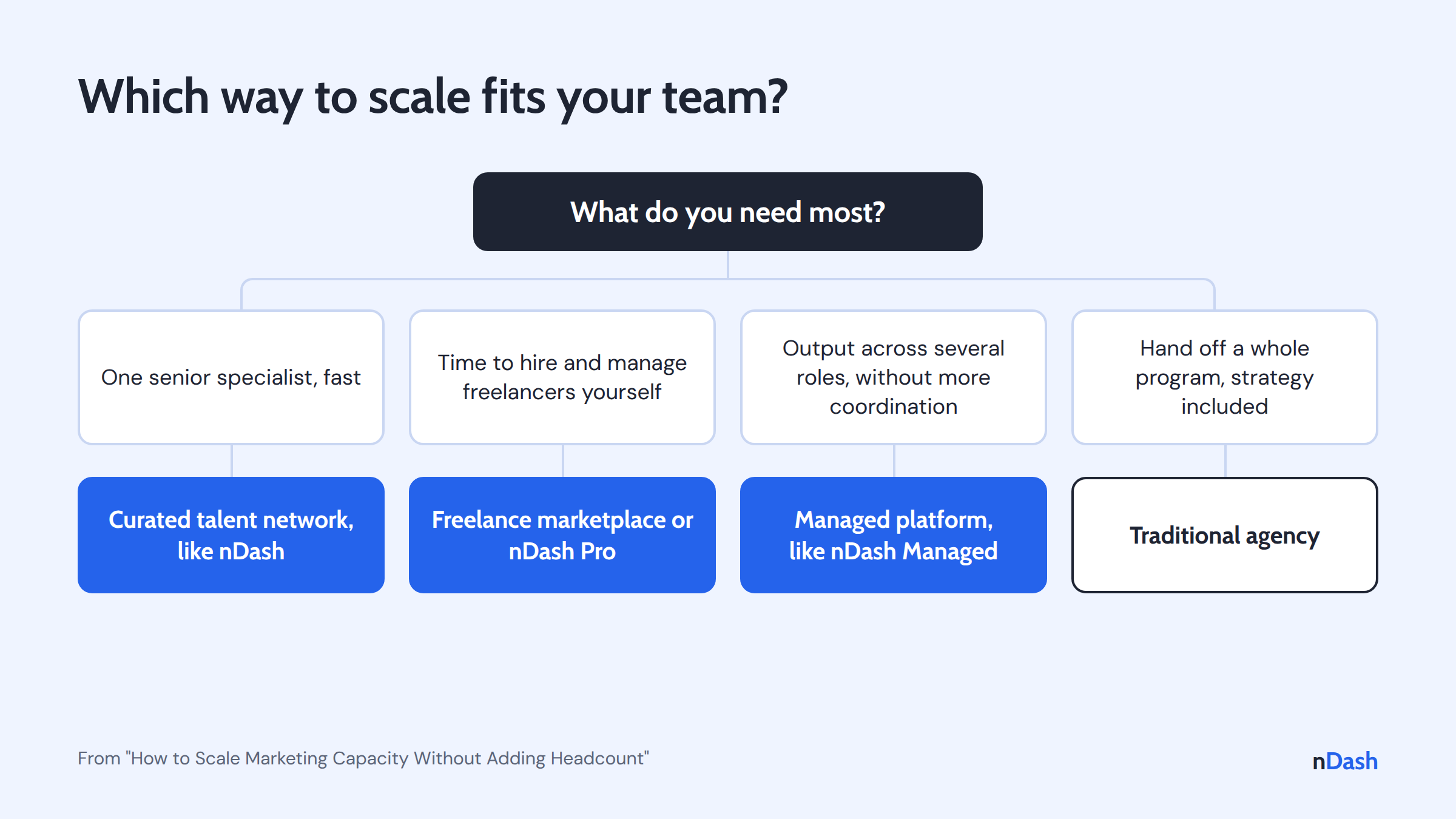
The best service for increasing marketing output without hiring depends on the work you need completed and how much of the process your team can manage. A curated network may suit one specialist, a marketplace for hands-on freelancer management, a managed platform for several roles, and an agency for broader program ownership.
Use the following decision guide to narrow your options.
- You need one experienced specialist quickly: Consider a curated talent network that can match you with someone who already understands your industry.
- You have time to recruit and manage freelancers: Consider a freelance marketplace or a self-managed talent platform such as nDash.
- You need several marketing roles but little additional project management: Look at managed talent platforms that oversee execution across disciplines.
- You want someone to own an entire marketing program: Consider a traditional agency offering both strategy and execution.
Why does the range of available marketing talent matter?
Many companies start by outsourcing a specific need. They might hire a writer to handle blog articles, then discover they also need editing, SEO, design, email production, or campaign support. Using separate providers for every new requirement can create additional administrative work. A partner offering access to multiple disciplines may allow you to expand your marketing activities without repeating the vendor selection process.
Through nDash, companies can find freelance writers, editors, designers, SEO specialists, email marketers, social media professionals, PPC specialists, PR professionals, multimedia creators, and AI strategists. Before choosing a provider, consider both your current requirements and the adjacent services you may need as campaigns develop. You don’t necessarily need to purchase those services immediately, but knowing they’re available can make future planning easier.
Which outsourced marketing teams are actually worth the price?
Outsourced marketing services are worth the price when the total cost of completed work compares favorably with other ways of delivering the same results. Hourly rates and project fees are only part of that calculation. A freelancer offering a low initial price may appear attractive until your team spends hours rewriting the work. Another specialist may charge more but produce something that requires minimal editing. Both situations affect what your company ultimately spends.
How do you calculate the total cost of outsourced marketing?
Evaluate four types of expenses before comparing providers.
- Provider fees: Include freelancer rates, retainers, subscription charges, platform fees, and other required payments.
- Internal team time: Account for briefing, reviewing, editing, answering questions, and managing assignments.
- Ramp time: Consider how long it takes before the freelancer consistently delivers work that meets your expectations.
- Unused services: Identify whether you’ll pay for unused hours, minimum project volumes, or resources during slower periods.
A good starting point is to divide your total production cost by the number of completed, approved assets.
Total cost per finished asset = (Provider fees + internal labor costs + other production costs) ÷ approved assets
For example, imagine comparing two writers. One offers a lower article rate but regularly requires three substantial rounds of revision. The other charges more and usually delivers an acceptable draft after one round of feedback. The second writer may cost less overall once you account for the time your employees spend editing.
The same thinking applies when comparing outsourcing against a permanent hire. Salary alone won’t capture the full cost of employment. You also need to consider benefits, equipment, recruiting, onboarding, and supervision. Sometimes, hiring an employee makes more sense. If your company has consistent, full-time work that requires the same expertise year-round, a permanent team member may be more economical and easier to integrate into daily operations. However, when demand changes frequently or your projects require several unrelated specialties, flexible talent may provide better value.
Where can I find reliable freelance marketers for short-term projects?
You can find freelance marketers for short-term projects through marketplaces, curated talent networks, and managed platforms. For assignments with tight deadlines, prioritize proven experience and reliable matching over availability or price alone. A short project leaves little room for several unsuccessful attempts. Someone producing a time-sensitive case study, campaign asset, or executive article needs to understand the assignment and deliver work that requires manageable revisions.
What should you check before hiring a freelancer?
Use this checklist to evaluate candidates and prepare assignments:
- Relevant work samples: Review examples that demonstrate experience with your industry, audience, and required format.
- A manageable first assignment: When possible, start with a smaller project before committing to a major campaign.
- A detailed brief: Include the audience, objectives, deliverables, deadlines, brand guidelines, and examples of successful work.
- Access to internal experts: Identify who can answer questions or provide technical information during production.
- A backup plan: Find out how quickly your provider can recommend another freelancer if the first match doesn’t work.
If your company engages independent professionals directly, you should also pay attention to worker classification. Whether someone counts as an employee or an independent contractor depends on the following:
- How much control the company has over how the work is done
- Who controls the financial side of the job
- How the two parties relate to each other
Calling someone a freelancer in an agreement doesn’t settle those questions on its own. Setting up the right working arrangement at the start can help avoid complications as the relationship develops.
How can I find a content writing service for seasonal demand?
A content writing service suited to seasonal demand should let you increase production before busy periods and reduce spending when the workload declines. Look for flexible project volumes, access to experienced writers, and contract terms that match your marketing calendar. The timing of your engagement also matters. Starting the search when you’re already behind schedule leaves little opportunity for a new writer to learn your brand.
How should you prepare freelance writers for seasonal workloads?
Start by reviewing your marketing calendar and identifying periods when you’ll need additional content. Product releases, annual events, promotional campaigns, and client activity may all create recurring increases in production.
Once you’ve identified those periods, follow these planning steps:
- Identify your production peaks: Estimate the types and quantities of content you’ll need for each major campaign or seasonal initiative.
- Bring writers in early: Start onboarding several weeks before the busiest period, giving you more time for technical or research-intensive assignments.
- Maintain relationships with successful freelancers: Assign occasional projects between busy periods so experienced writers stay familiar with your brand.
- Reduce assignments when demand declines: Choose contractual arrangements that let you adjust project volumes without unnecessary ongoing expenses.
Companies that prepare freelancers before a busy period are better positioned to increase production without spending the opening weeks of a campaign correcting misunderstandings.
Frequently asked questions
How do you scale marketing capacity without hiring?
You can scale marketing capacity without hiring by bringing in freelance specialists through marketplaces, curated talent networks, or managed platforms. Choose based on your workload, available management time, and contract requirements.
What is the fastest way to scale marketing capacity?
A curated or managed talent platform can help you find pre-vetted freelancers without conducting the entire search yourself. Allow time for onboarding and brand familiarization, particularly for technical assignments.
Is it cheaper to hire freelancers than full-time employees?
Freelancers can be less expensive for irregular workloads or specialized projects because companies generally pay for specific services instead of ongoing employment costs. Compare the full cost of each approach, including internal management time and employee benefits.
Does nDash require a long-term contract?
nDash offers self-managed services without ongoing project minimums. Managed engagements currently begin with a three-month commitment, so review the terms of the service you’re considering.
How long does it take a new freelancer to ramp up?
Ramp time depends on the work’s complexity and the information available to the freelancer. Straightforward assignments may require little onboarding, whereas technical content and highly specialized projects generally take longer.
What happens if a freelancer isn’t a good fit?
nDash uses feedback from the initial assignment to identify a better match. Clients can work with the team to address issues related to expertise, communication, workflow, or overall fit.
Can agencies use nDash for white-label work?
Yes. nDash supports white-label arrangements, including agency-branded communication and freelancer NDAs that follow the agency’s preferred process.
What marketing roles can I hire through nDash?
nDash provides access to freelance writers, editors, designers, SEO specialists, email marketers, social media specialists, PPC professionals, PR experts, multimedia creators, AI strategists, and other marketing professionals.
Can I try nDash for free?
You can create a free nDash account to explore the platform and available talent. Paid membership or an appropriate service plan is required to begin engaging freelancers.
Ready to scale marketing capacity without the management overhead?
Adding marketing output doesn’t have to mean adding more people to your payroll or more work to your team’s schedule. nDash helps brands and agencies find qualified freelance talent, build teams around their needs, and manage production as workloads change. Whether you want to oversee freelancers yourself or hand off day-to-day execution, we can help you find the right arrangement.