
Layoffs suck. Obviously, for those directly impacted it’s an extremely challenging time.
For the marketers who stay on with the company, it’s challenging, too. The pipeline target probably isn’t shrinking as much as the team is. You wake up the next morning with the same goals, fewer people, and a leadership team that still wants results.
The pattern is pretty predictable.
Federal labor data shows companies tend to cut contract and temp workers first, then permanent staff (BLS Monthly Labor Review). In marketing, Gartner’s 2025 CMO Spend Survey found 39% of CMOs planning to cut agency budgets, and the same share planning labor cuts.
In light of the recent layoffs throughout tech and digital – e.g. Microsoft (2%), HubSpot (7%), Amazon (~10% of corporate staff), Netflix (6%), eBay (9%), et al. – I wanted to put together a practical playbook for CMOs and marketing leaders in the weeks after the cuts, backed by research rather than hype.
Step 1: Triage the work that drives pipeline
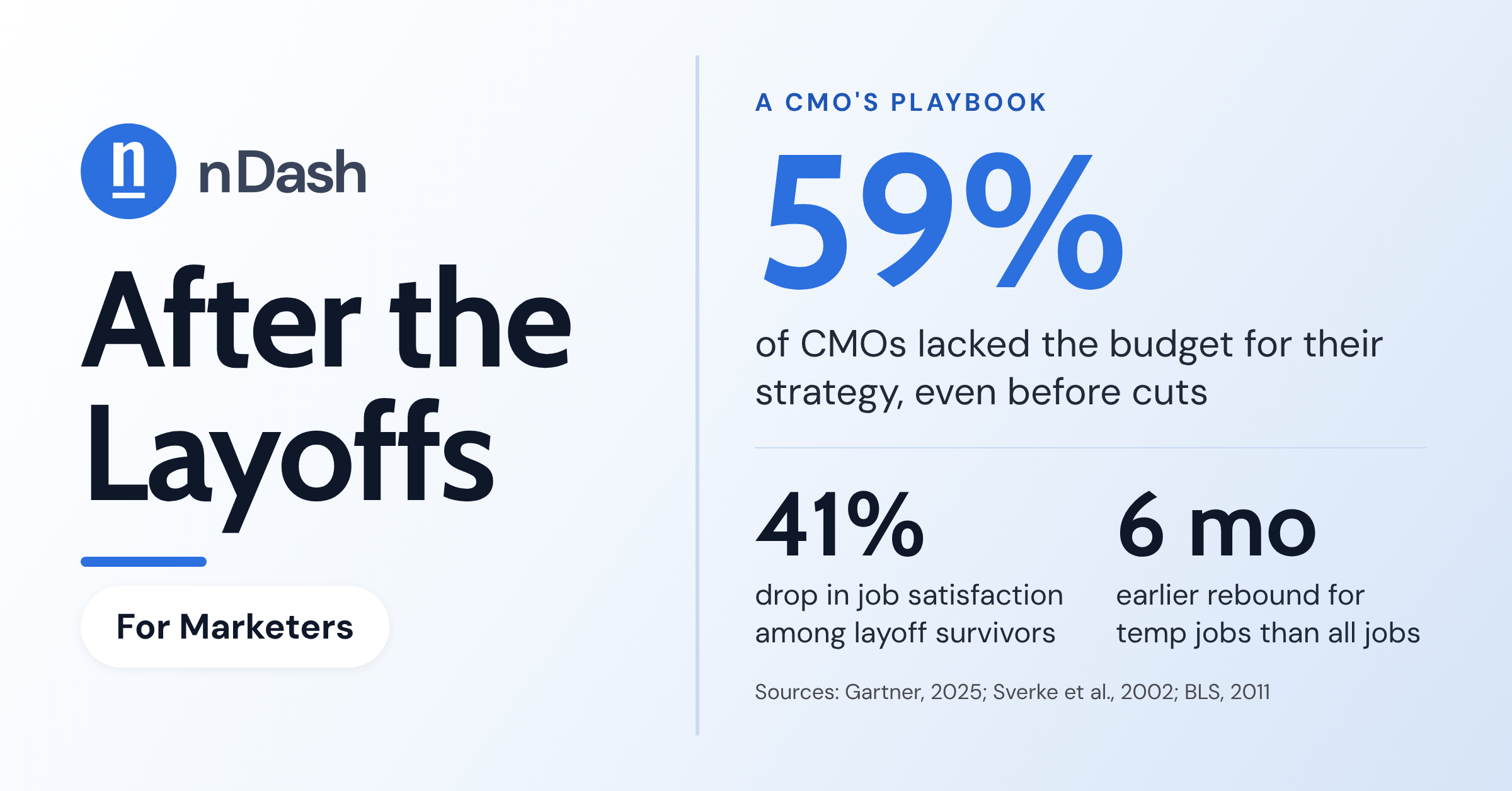
59% of CMOs told Gartner they lacked the budget to execute their 2025 strategy, and that was before any cuts.
So you can’t do everything the old team did. Decide what stops on purpose, otherwise it stops by accident, usually in the worst spot.
Harvard Business School professor Sandra Sucher, who has studied layoffs for years, notes that cuts lead to loss of institutional knowledge, weaker engagement, and higher turnover. Mapping the work is how you keep that knowledge from walking out the door.
Map it: List every recurring program and who owned it before the layoff. The gaps tend to hide in work nobody wrote down, e.g. the person who quietly updated case studies on the website every quarter, or kept the lead-routing rules in your CRM current.
Rank it: Keep what feeds pipeline and retention. Pause the nice-to-haves.
Say it out loud: Send leadership a short list of what’s paused. It resets expectations and keeps silent scope creep off your remaining team.
Step 2: Take care of the team that stayed
41% drop in job satisfaction among layoff survivors, according to a meta-analysis cited by UC Berkeley’s Greater Good Science Center.
The people who stayed are your most valuable asset and the research on how layoffs hit them isn’t pretty. Survivors also reported a 20% drop in job performance. A Harvard Business School study of a Fortune 500 tech company found new inventions fell by nearly a quarter after a 15% workforce cut.
Be direct: Tell people what changed and what didn’t. Uncertainty drains more energy than bad news. For example, hold a short team meeting the day after the cuts: who left, who now owns their work, which programs are paused, and whether more cuts are planned (if you know).
Remove work, don’t just reshuffle it: Handing one person a full second role is a fast path to a second departure. Instead, take each orphaned task and pick one of three paths: stop it, automate it, or hand it to someone with real capacity. That someone doesn’t have to be on payroll. Recurring, well-defined work (e.g. blog posts, case studies, webinar moderation) is often a good fit for a trusted freelancer, which keeps your core team focused on the work only they can do.
Protect thinking time: If ideas matter to your brand, that HBS finding is a warning. Guard creative time, not just output.
Step 3: Rebuild capacity flexibly (and dodge the common traps)
22% of large companies’ staff are contractors, temps, and freelancers, up from 16% a decade earlier, per a Staffing Industry Analysts survey.
A lot of companies backfill some of the lost bandwidth with contractors. That can work really well when it’s matched to the right kind of work.
My tip: Flexible talent shines on defined, project-based work (e.g. content, campaigns, a website refresh), specialized skills you need for weeks rather than years, and overflow that would otherwise land on an already stretched team. Start there.
Where you find them matters: Open job boards can mean a flood of applicants and hours of screening your team doesn’t have right now. The same goes for a “looking for a freelance writer” post on LinkedIn.
Applications on LinkedIn jumped more than 45% in a year, to roughly 11,000 a minute (Korn Ferry), so expect a pile of unvetted replies (plus a few awkward no’s to people in your network).
Timing matters too. A peer-reviewed study from KLU, Tilburg University, and KU Leuven found brand strength drops an average of 18% after a layoff announcement, and that advertising and social media activity amplified the damage (study summary).
A public call for help right after cuts can signal to customers, competitors, and the people you just let go that you’re scrambling to cover the gaps. Look for vetted talent with real B2B subject expertise, a direct line to the people doing the work, and one place to handle briefs, approvals, and payments. Otherwise the admin you saved by cutting headcount quietly lands back on your desk.
Step 4: Use AI for leverage, not as a headcount plan
22% of CMOs say generative AI has reduced their reliance on outside agencies for creativity and strategy, per Gartner.
That tracks: AI is great at speeding up drafts, research, and repurposing. But it still needs people with judgment and real subject knowledge to point it in the right direction and check the output. Pair the tools with the humans who actually know your buyers.
The research points the same way. A Stanford and MIT study of 5,179 customer support agents found generative AI raised productivity 14% on average, and 34% for newer, less experienced workers, but had minimal impact on the most experienced ones (NBER). In other words, AI helps people get up to speed faster. It doesn’t replace someone who already knows your market.
Use it to: Analyze GSC/Ahrefs data, draft content outlines, summarize research and call notes, repurpose a webinar into posts and emails, and speed up onboarding for new help (in-house or outside).
Keep humans on: Strategy, positioning, original ideas, and anything with your name on it. An expert editing AI output is faster than one writing from scratch, and far safer than publishing it unreviewed.
Step 5: Plan for the rebound now
6 months. That’s how much sooner temp jobs started recovering than overall employment after the 2007-09 recession, per the Bureau of Labor Statistics.
In plain terms, flexible talent is often the first to go and the first to come back. When budgets loosen, the teams that kept a bench of trusted outside talent can ramp in weeks instead of waiting on a full hiring cycle.
Keep your bench warm: Hold onto a short list of proven freelancers and partners, even if you pause them. A few ways to do that: tell them directly that you’re pausing, not ending, the relationship; send a small project every month or two so they stay current on your brand and products; keep their samples, rates, and past work in one place; and check in when budgets start to loosen, before you need them.
Write it down: Document workflows now, so new help (in-house or outside) can hit the ground running. For example: a one-page brand and voice guide, a content brief template, your approval steps (who signs off and how fast), a messaging doc for each product or persona, and a short list of what’s off-limits (claims legal won’t allow, competitors you don’t name).
After layoffs, a good strategy benefits the team, the marketing leadership, and the company.
The CMOs who come out ahead are those who cut work deliberately, take care of the people who stayed, add flexible capacity where it fits, and set the team up to grow again.
For the team: Clearer priorities, a workload that doesn’t double overnight, and a real reason to stay.
For marketing leadership: A credible plan to bring to the board, and a reputation as the leader who protected growth through the cuts, not the one who simply absorbed them.
For the company: Pipeline holds steady while costs come down, less turnover and lost knowledge, and a faster ramp than competitors when budgets return.
A personal note for any impacted marketers: We’re always looking to increase the level of talent in our community. While we can’t promise work or even a quick fix, we’d always love to have you join and are always happy to see new matches made! Sign up at https://go.ndash.com/signup/freelancer
Sources
- U.S. Bureau of Labor Statistics, Monthly Labor Review (2011)
- UC Berkeley Greater Good Science Center (citing Pfeffer, Sverke et al., and Amabile)
- Chief Marketer on Gartner’s 2025 CMO Spend Survey
- Demand Gen Report on Gartner’s 2025 CMO Spend Survey
- Harvard Kennedy School, “Why Many Companies Get Layoffs Wrong” (Sandra Sucher)
- Recruiting News Network (citing Staffing Industry Analysts and WSJ)
- Korn Ferry, “The Application Avalanche”
- KLU, Tilburg University, and KU Leuven: layoff announcements and brand strength (International Journal of Research in Marketing, 2023)
- Brynjolfsson, Li, and Raymond, “Generative AI at Work” (NBER Working Paper 31161; Quarterly Journal of Economics, 2025)