
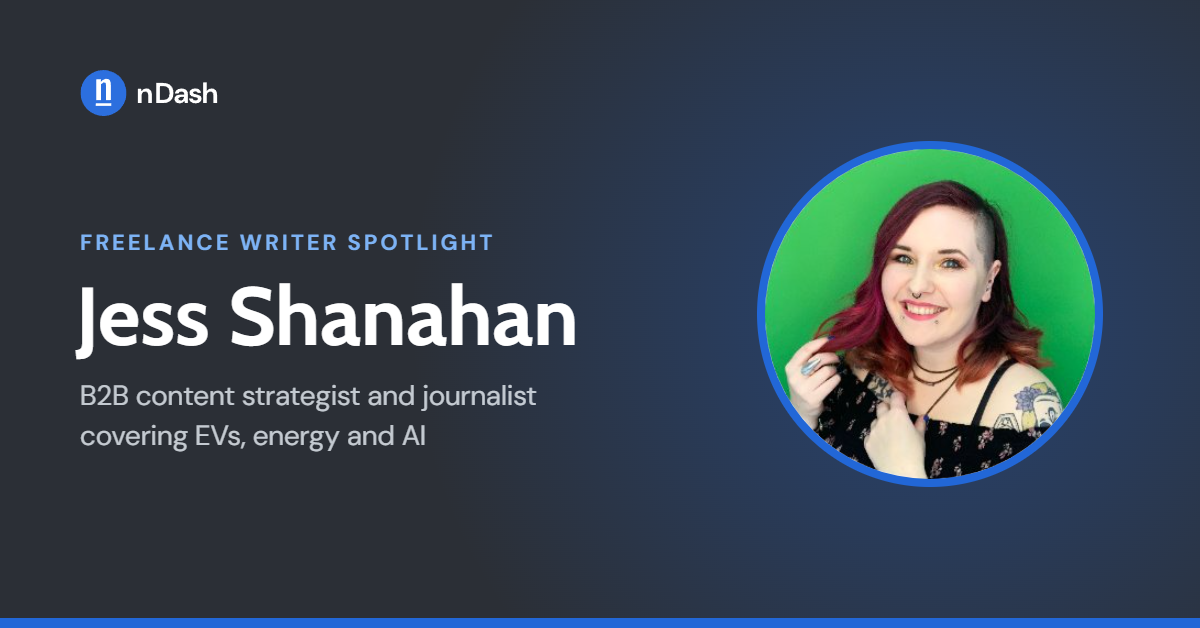
 UK-based freelance writer Jess Shanahan has been freelancing for 15 years, and for most of that time her name has been tied to electric vehicles. She writes B2B content across the EV ecosystem: automotive, energy, charging infrastructure and renewables, plus a growing body of work on AI and AI safety. Her specialty is translation. She takes engineering documents, data and conversations with technical experts and turns them into thought leadership, white papers and reports that people actually want to read. She’s also a regular on the conference circuit as a speaker, host and moderator.
I talked with Jess about why the most innovative brands are coming back to human storytelling, how she uses LinkedIn as her own testing ground, and why the best brief is sometimes a shorter one.
–
Mike: “What industries and types of content do you focus on?”
Jess: “I’ve been a freelancer for 15 years, and for most of that time my outward brand has been around automotive, particularly electric vehicles, mostly on the B2B side. That extends to energy and anything in the EV ecosystem: infrastructure, electricity, renewables. I’m very technical, so a lot of my work involves either taking technical documentation or talking to technical people, then synthesizing that into something engaging that people actually want to read.
“Often that’s thought leadership, or working with data and other primary sources to create white papers, reports and articles. I also dip into other industries. I’ve done a lot of work around AI, both for AI-enabled companies and around AI safety and governance, and across manufacturing, procurement and supply chain, especially where those processes are tech-enabled.”
Mike: “How did you get into technical writing? Were you technical first, or a writer who wasn’t afraid of technical topics?”
Jess: “I’ve always been someone who learns really quickly. Early in my career I’d take any work I could get. One of the first sets of articles I wrote, back around 2012, was about pallet trucks in factories, so I had to quickly learn what that meant. Ever since then I’ve been able to adapt.
“But I’ve found my specialist subject now. I’m really tapped into energy markets, EV sales and the wider automotive manufacturing world, especially in the UK and Europe. I’m around technical people a lot. My partner’s a software developer (and I dabble in coding as a hobby), and I’ve had technical clients for a long time. I like to think of myself as the translator between engineering or developer teams and the marketing team or the wider brand audience.”
Mike: “Who is the end reader for most of your work?”
Jess: “Usually someone non-technical. I do plenty of technical writing, but most of my work is on the thought leadership side. That might be for CTOs who are technical but time-poor and want something engaging for LinkedIn or a company blog. Or it’s audience-driven content that takes a company’s technical capabilities and explains them in a way that makes sense and is also engaging.
“It’s about the angle. Rather than ‘our product does this, and this is why we’re technically better than anyone else,’ I’m there to translate that into: what does it mean to this audience? Not necessarily a lay person, but a non-technical one.”
Mike: “A lot of writers are anxious about AI, yet clients still come to you. Why do you think they’re sticking with human writers?”
Jess: “The clients who were doing content for content’s sake have all gone the way of AI. They were probably more focused on price.
“The people coming to me now are further along in their content marketing. They’ve realized AI-generated content might be fine for some things, but not where they need to stand out or explain certain capabilities. I have a journalistic background, and they want that narrative and storytelling element. Even where I’m not doing pure writing, I’m helping set their strategy, making sure they say the right things to the right people at the right time.
“AI still can’t replicate knowing what makes a good story. With a great prompt you might get something out of it, but it’s still lacking, often recognizable, and it won’t match a brand’s voice.
“My client base has really changed. There’s much more strategy in my work now. I also work with agencies that have built a strong narrative strategy and need someone with the skill and subject knowledge to pull it off. Either way, it’s the more innovative companies that are looking for proper storytelling rather than just content.”
Mike: “You started out as a generalist. Why did you decide to niche down?”
Jess: “When I started, I was a generalist because I could write, and I did a bunch of stuff across industries. But I niched down over 10 years ago. Maybe it’s my entrepreneurial brain, but trying to serve everyone wasn’t positioning me where I wanted to be. I could have kept writing lots of lower-paid articles for volume, but I had real interest in these specialisms, especially electric cars.
“It also made my marketing and sales so much easier. It was far simpler to find the right brands to work with than taking a scattergun approach.”
Mike: “You publish a lot of your own content. Why do you keep doing it, and does it drive results?”
Jess: “Two reasons. First, I love writing, and it’s nice to pick a topic and write it for myself. Second, I’m testing things.
“When some of my work fell away because of AI, I took on more speaking work. I’m often on stage at conferences, hosting a stage, lining up speakers, moderating sessions or giving talks. It’s been very lucrative, and AI isn’t going to take it. Even though I already had a strong brand, I wanted to go all in on my own content so people knew my expertise. So it’s partly a marketing tool for the speaking work.
“I also wanted to test whether LinkedIn articles are as powerful for SEO as everyone says. They are. It takes me about a day to rank number one or two on Google for most of what I publish. Next I’m testing LinkedIn video. All of this is knowledge I can pass on to clients when I’m doing similar work for them.”
Mike: “You’ve been doing a lot of work on AI safety. What got you interested?”
Jess: “I came at AI from a pretty negative place. It was taking my work, and I was frustrated. I still am, to a point, but I’m trying to see the opportunity to do something more human, and maybe more fun, with my work.
“Then I took an AI literacy course because I was curious about uses beyond writing, like vibe coding and building apps. That course showed me how much risk people weren’t understanding, from hallucinations damaging a company’s reputation to much bigger questions about what AI does to society over the next five or 10 years. So I took BlueDot’s AGI strategy course, which looks at future risks and pathways to harm, like the disempowerment of workforces.
“It connects back to my industry, too. Critical infrastructure like energy and electricity grids is where my sector uses AI and where there’s real risk of it. It can be a little depressing, but it’s fascinating. I’m also really interested in the cognitive effects AI has on people.”
Mike: “You mentioned the most innovative brands are coming back to human storytelling. That’s the opposite of how it’s usually framed. What’s driving that?”
Jess: “Those companies have done all of it. They’ve published at scale, they’ve used AI, and they’ve more or less nailed it. Then they realized that now everyone’s doing it, their writing sounds exactly the same as everyone else’s, and they need to do something different. They’ve been through the journey and come out the other side.
“It’s not that they’ve stopped using AI. They’ve found better applications for it. There’s a lot of pressure to use AI, and the easiest way is to generate content, graphics or video. The better use is agentic AI and automations that push a workflow along or hand off between agents, while keeping humans in the loop for the creative work. That’s much harder to implement. Companies that are only now adopting AI haven’t reached that level of maturity yet.”
Mike: “Content briefs have become long and formulaic. Will we ever get back to giving writers more room?”
Jess: “Those briefs came from a place of ‘we know what works for search engines.’ But when something is formulaic, AI is actually pretty good at it, at least at ticking boxes. Reading it as a human is another matter.
“Now so many people use AI to search, whether you call it AEO or GEO, and people are leaning more on trust. That’s why LinkedIn articles do so well, along with the big publications and government sites. I think voice is what will make people stand out. It’s great to rank number one in an LLM or on Google, but if nobody actually reads the piece, because people increasingly just read summaries, what difference is it making?
“That’s why I focus on LinkedIn: people are on that platform reading. The same goes for Medium and Substack. If you inject some voice or a journalistic angle, people pay attention and keep coming back.
“A brief really depends on the writer. One client used to send me briefs with keywords, the audience and every headline, all generated by their AI tool. I told them to give me only what I absolutely need to include, and not to try to help, because I do better without that kind of help. Now they occasionally send headers, but mostly as a signal of the keywords they’re targeting. From there I have the flexibility to bring my industry knowledge, a journalistic angle and what I know about their product, and turn it into something far more compelling than ‘write under these headlines.’
“If you go to a journalist because you want something narrative and story-driven, you can’t hand them the headers. It has to be the premise, the topic, maybe a few keywords, or a conversation with an expert. I do a lot of expert interviews to inform what I write.”
Mike: “So maybe the new goal is getting people to read and come back, rather than ranking for a term?”
Jess: “In some industries, search still makes sense. If you’re a local bakery, of course you should be doing SEO. But for technical companies, or anyone targeting the C-suite, a CTO isn’t searching for which SaaS product to buy.
“That’s where an account-based approach comes in: content at lots of different touchpoints, whether it’s LinkedIn, the website, a video or an ad at a conference, all very specific to a small group of people in your target market. I think that’s far more powerful now than ‘let’s rank really highly and it will work out.’ B2B marketing is different these days.”
Mike: “Are you taking on new clients?”
Jess: “Yes. I’ve just wrapped a big project, so I have plenty of availability in the run-up to Christmas, and capacity into next year alongside other projects and speaking work.”
Would you like to work with Jess? Check out her freelance writing portfolio here.