
Marketing teams today have more channels, campaigns, and tools than ever before. But few teams can hire a full-time specialist for every skill they need, and relying on an agency for everything can be expensive and limiting. A hybrid marketing team offers another approach, combining in-house expertise with on-demand freelance talent.
This model is the structure behind elastic marketing, built for teams that need to move fast without adding headcount.
New to the series? Start with: What Is an Elastic Marketing Team (And Why You’ll Need One in 2027)
TL;DR: Is a Hybrid Marketing Team Right for You?
Use this summary to decide whether a hybrid marketing team fits your organization:
- Combine an in-house core that owns strategy with outside specialists who help shape and execute it.
- Keep brand strategy, messaging, campaign planning, and final review in-house.
- Recognize where in-house-only teams fall short, including limited skills, bandwidth issues, and high costs for niche roles.
- Watch for traditional agency trade-offs such as long contracts, inconsistent brand voice, and opaque costs.
- Use a vetted talent network, a standard brief, and one editor who protects your brand voice.
- Spread work across your team and outside specialists so one departure or budget cut doesn’t stall your plans.
- Check your last two quarters for warning signs before you change your structure.
What is a Hybrid Marketing Team?
A hybrid marketing team blends two kinds of talent. Your in-house team sets strategy, owns the brand voice, and knows the customer. Outside specialists, whether freelancers, fractional leaders, or a targeted agency, handle work that needs niche skills or extra hands.
Unlike outsourcing, a hybrid model keeps your internal leaders in charge, and outside contributors plug into your tools, workflows, and standards. Here’s how the work typically splits:
| Stays in-house | Flexes with demand |
| Brand strategy and positioning | Content production during launches |
| Customer insight and messaging | SEO and AEO/GEO |
| Campaign planning and goals | Design and creative production |
| Final review and brand standards | Paid media and email campaigns |
Where Do In-House and Agency Marketing Models Break Down?
In-house teams can’t flex with demand, and agencies take day-to-day work off your plate. On paper, both classic models look stable. A static in-house team knows the brand. An agency brings capacity and process. In practice, both were built for predictable years, and marketing leaders aren’t getting predictable years.
What are the limits of an in-house marketing team?
A fully in-house team works well when the workload is steady. When it isn’t, the team can’t scale up or down to match it. Here’s why:
- Limited skills in fast-moving areas: SEO, paid media, and AI tooling change faster than a small team can keep up with.
- Fixed capacity: A launch or rebrand doesn’t come with extra headcount, so the same people absorb the spike.
- High fixed costs for niche roles: Keeping a graphic designer or SEO strategist on payroll year-round only makes sense if you need one year-round.
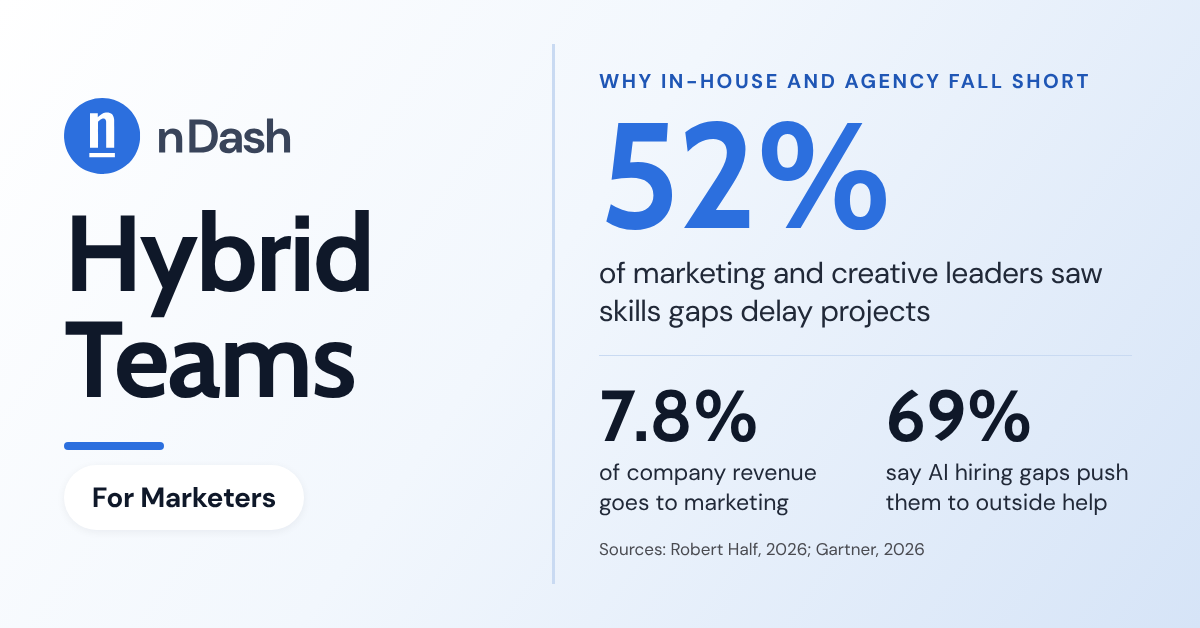
Skills gaps have a real cost. In Robert Half’s 2026 Demand for Skilled Talent report, 52% of marketing and creative leaders say skills shortages delayed projects in the past year.
What are the downsides of a traditional agency retainer?
Traditional agency retainers add capacity by taking work outside, but that comes with trade-offs:
- Long contracts: Annual retainers lock you into a scope, even when priorities shift mid-year.
- Slow onboarding and voice drift: An agency team has to learn your product and tone, then learn it again when account staff rotates.
- Opaque costs: Markups and bundled fees make it hard to see what each piece of work actually costs.
When a retainer agency runs the work day to day, you can end up planning around its priorities and schedule instead of setting your own. Whatever partner you choose, look for flexible scope, transparent pricing, and a consistent team that learns your brand.
What goes wrong when you hire freelancers without a system?
Many teams try to fix both problems by hiring freelancers directly. Without a system, that creates another set of issues:
- Plenty of options, little quality control: Finding a freelancer is easy. Finding a reliable specialist who knows your industry isn’t.
- Vetting eats internal time: Every new contributor means portfolio reviews, test projects, and contracts.
- Disconnected work: Freelancers who never see the brief or the brand guide produce work that needs heavy rewriting.
A managed talent network prevents these problems by vetting specialists, sharing your standards, and handling contracts before work begins.
In-House vs. Agency vs. Hybrid Marketing Team
| In-house | Agency | Hybrid marketing team | |
| Ownership | Internal team owns everything | Agency manages most work | Internal team owns strategy, specialists help shape and execute it |
| Flexibility | Fixed capacity | Long contracts slow pivots | Capacity scales with demand |
| Skills | Limited to current staff | Limited to the agency’s bench | Specialists matched to each project |
| Brand consistency | Strong | Risk of drift | Internal oversight keeps it consistent |
| Cost structure | Salaries year-round | Retainers and markups | Project-based spend |
| Best for | Steady, predictable work | Large, stable scopes | Ongoing work that needs control and agility |
A hybrid team pairs the brand control of an in-house team with the flexible capacity of an agency, without the long contracts. With a bench of vetted freelancers already in place, a tight deadline or an unfamiliar project doesn’t send you looking for a new vendor. Your team decides when and how to bring in support, instead of a retainer deciding for you.
Why Do Hybrid Marketing Teams Hold Up Under Pressure?
Spreading work across people, partners, and budget lines means no single change can stall your marketing. Let me explain:
- No single point of failure: If a key hire leaves or an agency relationship ends, specialists on your bench keep work moving while you regroup.
- Budget cuts land softly: Outside spend can shrink first, which protects your core team when finance asks for savings.
- New skills arrive faster: When a channel or tool changes, you can bring in someone who already knows it instead of waiting on a training plan.
Gartner’s 2026 CMO Spend Survey puts marketing budgets at 7.8% of company revenue, about 18% below the 9.5% CMOs reported in 2022. Hiring is getting harder too, and 69% of marketing and creative leaders surveyed by Robert Half say AI-related hiring challenges have made them more likely to turn to a staffing or consulting firm.
Here’s what a hybrid marketing team looks like across industries:
- A software company keeps product marketing in-house and brings in freelance writers and designers for its annual product launch.
- A healthcare brand pairs its content lead with freelance medical writers who know the regulations.
- A manufacturer adds a paid media specialist in the months leading up to a major trade show.
- A B2B marketing agency adds vetted freelance writers when a new client signs, instead of hiring before the revenue is steady.
nDash customers see the same pattern. Analytix Solutions, an outsourcing provider in IT, accounting, and healthcare, needed more top-of-funnel content than its in-house team could produce. After adding nDash writers and a shared brief template, it cut content editing and proofreading costs by 50%. Orange Marketing, a B2B marketing agency, uses nDash writers to cover clients in very different industries and cut its editing, revision, and project management time by at least 20%.
How Do You Run Content With a Hybrid Team?
Treat freelance writers as an extension of your editorial team, with the same brief, editor, and standards for every piece.
- Start every piece with a real brief: Include the audience, angle, target keywords, sources, and two or three published pieces that sound like your brand.
- Give one editor final say on voice: Ten writers can sound like one brand when the same editor reviews every draft against your style guide.
- Interview your experts instead of asking them to write: A 30-minute call gives a freelance writer the insight that makes B2B content credible, without pulling your subject matter expert into drafting.
- Set your AI policy up front: Tell writers where AI tools are allowed, ask them to disclose how they use them, and check drafts for originality before you publish.
- Match writers to your industry: A writer who already knows healthcare regulations or manufacturing buyers needs less editing and fewer rounds of revision.
How Do You Know You Need a Hybrid Marketing Team?
You likely need a hybrid marketing team when the same strains keep showing up in day-to-day work, such as a backlog that grows every quarter or requests that sit unassigned for weeks. Each sign is easy to write off as a one-time crunch, so look back over the last two quarters instead of the last two weeks.
See how many of these apply to your team:
- Your agency retainer covers work you no longer need, but not the work you do.
- Every new channel turns into a hiring request that won’t get approved this year.
- The same two or three people absorb every workload spike.
- Freelancers you’ve hired ad hoc need heavy rewrites to sound like your brand.
- You pass on good opportunities because no one is free to take them on.
If two or more of these sound familiar, your team is ready for a hybrid model. Our next post walks through how to build one, step by step. When you’re ready to add specialists, nDash connects you with vetted freelance writers, designers, and SEO strategists, plus managing editors who handle briefs, edits, and payments.
Frequently Asked Questions
What is a hybrid marketing team?
A hybrid marketing team combines an in-house core with outside specialists. The internal team owns strategy, brand voice, and customer insight, while freelancers, fractional leaders, or targeted agencies handle specialized or overflow work. The mix shifts with demand, so you add skills when campaigns need them and scale back when they don’t.
How much of a hybrid marketing team should be in-house?
There’s no fixed ratio. A useful rule is to keep any role you need every week in-house and bring in specialists for work that comes in bursts. Most teams start with a small core that owns strategy and review, then add outside capacity one function at a time as they see results.
Who manages a hybrid marketing team?
An internal marketing leader sets priorities and owns the results. Each project needs one internal owner to set direction and sign off on the work. To keep coordination from piling up, many teams route freelancers through a managing editor or talent partner that handles assignments, onboarding, contracts, and payments. As a result, marketers review finished work instead of managing every contributor.
What’s the difference between a hybrid and an elastic marketing team?
Hybrid and elastic describe the same idea from two angles. “Hybrid” describes the structure, which includes an in-house core plus outside specialists. “Elastic” describes how that structure behaves, scaling up and down with demand. A well-run hybrid team is elastic.
Is it safe to share confidential information with freelancers?
Yes, with the right safeguards. Have every freelancer sign an NDA before they see a brief, share only what each project needs, and work with a talent partner that manages those agreements for you.