
Budget typically drives most content marketing conversations. A natural next step is for teams to begin developing plans that align with available resources and expected outputs. That works fine at first, but there’s something they’re not accounting for. Content marketing volatility often unexpectedly shows up following campaign execution.
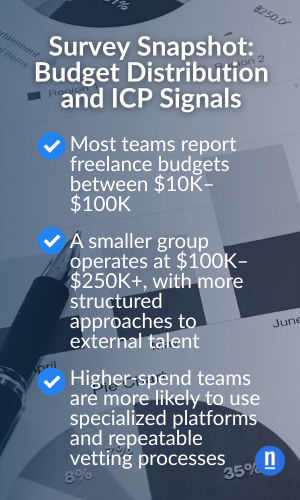
That causes campaigns to shift, priorities to change, and planned spending no longer aligns with results. Our Q1 2026 survey shows how this plays out in practice, with talent vetting and inconsistent quality slowing execution and disrupting momentum, even though neither gets factored into planning or budgeting.
Marketing Volatility is the Real Budget Risk, Not Budget Size
Budget risk has less to do with spending levels and more to do with execution slowing or stalling. Most teams focus on budget allocations, total spend, and channel performance. Problems show up later, when vetting slows and execution stalls, because none of that was built into the plan.
Content marketing volatility shows up in how often work gets restarted. For example, a campaign launches for one audience, then shifts a few weeks later to a different target. Creative changes. Targeting changes. Spend moves with it. The first version never runs long enough to produce a clear signal, so there’s little to learn from it. Results reflect fragments instead of a full campaign. By the time performance data comes in, teams have already spent most of the budget.
Measurement breaks down because execution never settles. That gap shows up externally as well. Amy Essig, Director of Client Strategy at Complete Game Consulting, explains that prospects are making decisions based on what they find online. If expertise isn’t visible, someone else fills that gap. She says, “Your prospects are making decisions right now based on what they can find online. If you’re not putting your expertise out there, someone else is filling that gap.”
Teams misdiagnose the problem and respond in predictable ways:
- A bigger budget will fix missed targets
- Teams reallocate spend to correct underperformance
- Calls for more efficiency when execution starts to strain
Chris Lang, CEO of MOVE, points out that teams often blame the content. “The instinct is to blame the content. Tweak the hook, try a different format, hire a better editor. The carousel becomes a reel. The reel becomes a talking-head video. Still eleven likes. The problem usually isn’t the content.”
Stable-Era Planning Breaks Under Marketing Volatility
Traditional planning models were built for a different kind of market. Demand moved more slowly. Channels were easier to predict. Teams could set a plan at the start of the year and expect it to hold long enough to execute against it. That’s the assumption behind annual planning.
That assumption doesn’t hold anymore. Demand shifts mid-cycle. Channels don’t behave the same quarter to quarter. New priorities arise before existing work has time to be completed. When inputs change that often, a fixed plan starts to work against the team rather than support it.
Annual planning is built on a set of decisions that are meant to last. Budgets are locked. Campaign calendars are mapped out in advance. Headcount is set based on expected workload. All of that depends on stability. The audience you planned for needs to stay relevant. The channels you chose need to keep performing. The volume of work needs to match what the team was staffed to handle. When those conditions hold, the model works. Teams can focus on execution instead of constantly adjusting course.
When Content Marketing Volatility Turns Efficiency Into a False Signal
Efficiency metrics often look strong, with costs per asset declining and output rising. On paper, content plans and strategies appear to be working well. The problem is that those numbers don’t show how often disruptions occur. Joe Morrison, founder of Insight2Strategy, notes, “Companies invest seriously in educational content — and their buyers still walk away confused. Not because the content is bad. Because the assumptions underneath it are wrong.”
The same issue shows up in execution. Volume alone doesn’t say much about whether content reaches the market or performs as intended. Kathleen Lucente, founder of Red Fan Communications, writes, “Most content programs are just expensive noise machines.” The same pattern appears in our Q1 2026 survey. Respondents point to inconsistent quality as a significant pain point. That’s often tied to the time it takes to vet talent and the difficulty of scaling that process.
These metrics assume a straight path from planning to execution. Volatility breaks that assumption. Measurement loses reliability when execution does not follow a consistent path, which makes it harder to interpret performance or forecast outcomes.
Volatility creates costs that don’t show up in reports but still affect performance and budget outcomes. For example, organizations report wasting an average of 25% of their marketing budget on efforts that look successful on paper but fail to drive meaningful results. Over time, teams put in more hours to maintain the same output, while budgets support work that never reaches the market. Output may hold steady, but the cost behind it continues rising.
Elastic Capacity Reduces Marketing Volatility Budget Risk
Stability depends on whether capacity can adjust without going back to the drawing board. Planning for volatility shifts the focus from fixed capacity to the range of demand that teams can support. Clare Price, President and CEO, Octain Growth Systems, notes, “The question is whether you have a system to produce it consistently — or whether it happens when you have time (which is never).” That’s the shift.
Instead of locking into a fixed number of assets, teams plan for a flexible range and adjust as demand changes. As priorities shift mid-cycle, they don’t start over. They keep the work moving and build on what’s already in progress. Those who can make those adjustments in real time are 1.5× more likely to change campaigns as results come in.
The difference shows up in execution. Work keeps moving. Teams aren’t going back into pieces they thought were finished just because something changed. That alone changes how spending behaves. It has time to play out rather than being interrupted. Budget pacing tends to settle as a result. When priorities shift, it’s an adjustment, not a reset.
Marketing Volatility Requires a Different Definition of Budget Discipline
Efficiency can look better on paper without much changing underneath. Costs per asset drop, output goes up, and it all looks like progress. That tends to hold only while the work stays on track. Once it doesn’t, those gains don’t show up the same way, because not everything being produced actually makes it through.
Why Efficiency Metrics Don’t Capture Marketing Volatility Risk
Metrics such as cost per asset and output volume measure production, but they don’t show what happens after work begins. If messaging, targeting, or channels change mid-cycle, earlier work loses value before it performs. The numbers still count it as output.
That gap shows up in how performance is interpreted. Jock Breitwieser, Co-founder of SocialSellinator, explains, “Budget authority comes from visibility, not from performance alone.” When teams rely on efficiency metrics alone, they miss what’s happening inside the work. Visibility into how often plans change, and how that affects execution, matters just as much as the output itself.
How Volatility Creates Hidden Costs
The cost shows up once work is already underway. Something changes, and instead of moving forward, teams have to go back into it. Assets get adjusted. Campaigns lose time. Work that was close to being done gets pulled back into review. The effort is real, and it pulls from the same budget, but it doesn’t show up as additional output.
At the same time, some work gets repeated while other priorities wait. The capacity looks full, but not all of it moves work forward. Over time, teams put in more effort to get the same usable output, even as efficiency metrics suggest improvement.
Marketing Volatility is the Budget Risk Teams Can’t Ignore
Budget conversations tend to center on allocation. Most of the discussion comes down to how much to spend and where to allocate that budget. What happens after that gets less attention.
Priorities shift once work is underway. Campaigns change direction. Timelines move. Resources get pulled into new areas. A certain amount of change makes sense, but it doesn’t take much before the original plan no longer matches the work. At that point, performance becomes harder to interpret because it reflects a mix of decisions made at different times under different conditions.
FAQ: Marketing Volatility and Budget Risk
What does marketing volatility look like in day-to-day execution?
Marketing volatility shows up as constant shifts in priorities, campaigns, and channels. Those shifts disrupt execution and make budgets unreliable, no matter how much teams allocate.
Where does marketing volatility show up first in a campaign or plan?
Marketing volatility increases budget risk by forcing mid-cycle changes, restarting campaigns, and creating misalignment between planned spend and actual execution.
Why do plans drift within the first few weeks of a quarter?
Plans start to drift within the first few weeks of a quarter because the conditions they’re built around begin to shift once work is underway. Demand moves, timelines change, and the plan doesn’t keep up.
What are the early signs that efficiency metrics are hiding problems?
Early signs that efficiency metrics are hiding problems include rework creeping in. Timelines start to slip over time. Work doesn’t always make it to market. Output can still look steady.
What changes first when a team starts planning for volatility instead of precision?
Capacity planning tends to show up in capacity planning. The work is no longer built around a fixed number of outputs, and resourcing starts to shift as demand changes.