
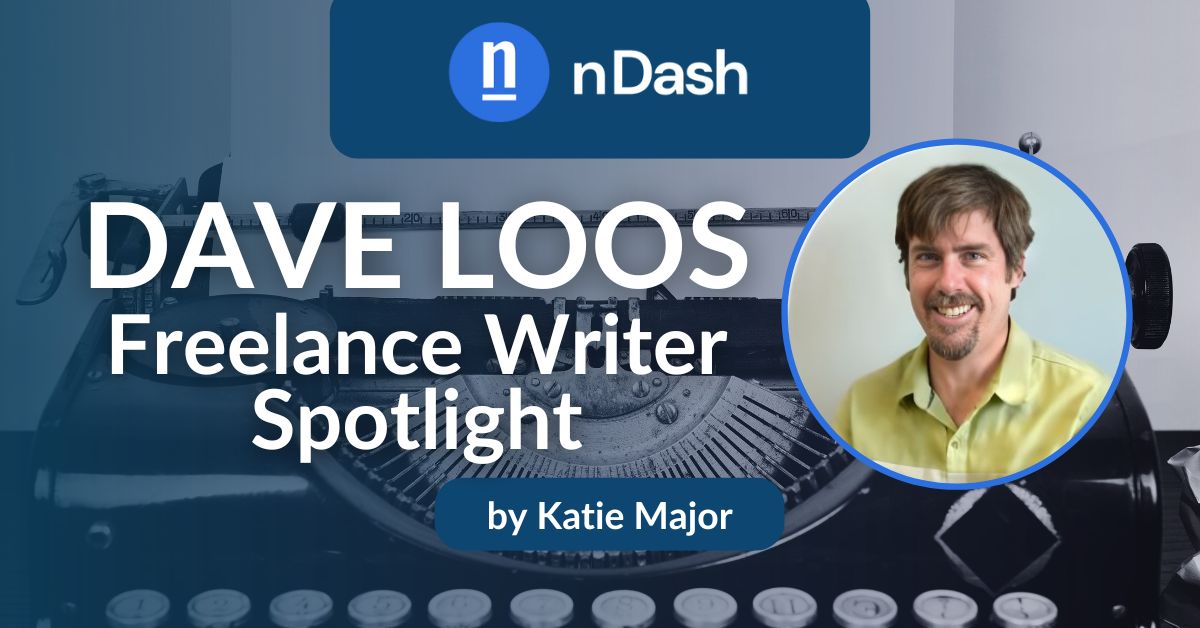
From the Hank Green Universe to Freelance Writer: Meet Dave Loos
If Tolkien’s “There and Back Again” was a physical concept, it would live in the personage of Dave Loos. Starting as a journalist with a passion for offbeat storytelling in the early 2000s, he went on to work as a scriptwriter for Hank and John Green.
If you came of age watching Crash Course or SciShow, Dave Loos likely helped shape the scripts behind your favorite lessons. He wrote scripts for biology, U.S. history, and countless science facts that made those YouTube rabbit holes so educational.
In this Writer Spotlight, we caught up with Dave to chat about his career evolution. We cover his early print journalism days to the 12-year run in the Hank and John Green universe. Now, Dave is taking it back to where he started and pursuing writing full-time.
Dave shares his thoughts on effective storytelling, niching down, and the realities of being a writer in an AI-driven world.
Background: The Freelance Writer Behind the Story
Early Days in Journalism
Katie: How did you first get into journalism?
Dave: I went to American University in D.C. and studied journalism. I jumped right into working at a chain of weekly papers in Northern Virginia right after college. That chain doesn’t exist anymore, which probably isn’t a surprise. I did that for two years, then went out to a daily paper in Frederick, Maryland. I think that paper still exists, but I don’t think it’s daily anymore. I think it’s five days a week, which is also indicative of everything going on with local journalism.
Katie: What kind of writing did you focus on during that time?
Dave: For the first couple of years, it was mostly general assignment. I think I was technically hired as a business reporter, but we all covered whatever needed covering. Eventually, I focused a lot on transportation issues, which were always a big deal in the suburbs of DC.
Katie: What drew you to writing in the first place?
Dave: Honestly, my high school history teachers. I knew even back then that I wanted to at least try out being a journalist. My teachers were the ones who got me excited about well-researched writing. My favorite teacher also taught a journalism class, and I was able to take two classes with him. We talked a lot about the impact of journalism; it was such a different world.
Katie: How would you describe your natural writing voice?
Dave: That’s a good question. I’ve always gravitated toward longer features or “offbeat” stuff. I did the “hardcore” nuts and bolts policy, but I wanted to do more long-form investigative or offbeat stories. I’ve done breaking news and policy, but I don’t love the nuts and bolts of it. One of my favorite stories was tracking the pardoned Thanksgiving turkeys from the White House to a local farm.
nDash’s Discussion With Freelance Writer David Loos
The Green Brothers Era
Katie: How did you end up working with Hank and John Green?
Dave: That was part two of my writing career. I moved to Missoula in 2006 for grad school to do environmental studies with an emphasis on writing at the University of Montana. I met Hank the first weekend I got here.
This was just before Hank and John started the Vlogbrothers channel on YouTube in 2007. It was one of the first really good success stories of a daily vlog. John was writing young adult novels that weren’t doing great at the time, but as they gained this new audience, John’s writing became more popular.
Hank had a blog called EcoGeek that was an intersection of environmental issues and technology. He later started one on environmental policy called Enviroonk. He knew I had done environmental writing and asked, “Do you want to edit this blog?” to which I said, “Sure, [why not?] I’m in grad school.” He brought me on to edit and assign stories to freelancers, and that lasted a couple of years.
Running Operations at DFTBA
Katie: And how did this role with Hank and John evolve?
Dave: Around 2010 or 2011. The real work with Hank and John began around here. By this point, they had become successful YouTubers, and they started Crash Course and SciShow, their two educational YouTube channels.
Crash Course does a full curriculum now, but they started with biology and U.S. history. SciShow was a more general science. They were aimed at high school and college students as free educational tools and supplemental material for teachers. I was one of the original writers for both, and I did that for four or five years.
Katie: So you did this for about five years. What was the next iteration of your work with them?
Dave: This was all freelance work to this point, and I was looking for something more full-time. Hank and John started DFTBA (Don’t Forget To Be Awesome). They hired me to run operations for that brand. For a while, I was juggling both the scriptwriting and my work at DFTBA. I eventually let the scripting go so I could focus on the full-time role, which I ended up doing for 12 years.
The scriptwriting took a while, especially the biology ones. My background isn’t in science, so those were challenging but fun. SciShow was a little easier for me since it was more flexible and general-interest.
Katie: This is so 2014, peak Tumblr era! I love it. You were there for a while as well. What did you do there?
Dave: Oh, yes, peak. It also feels like 40 years ago at this point. DFTBA was originally created as a record label for YouTubers to sell their music because Hank wanted to sell his music. That quickly morphed into a general merchandise company for creators. They moved it to Missoula; it was tiny. I was one of three employees as the operations manager.
We got bigger. We kept moving to different, larger warehouses as we grew, bringing on more creators and eventually podcasters. Then the pandemic hit, and things went berserk because e-commerce blew up. It was kind of a success catastrophe; everything grew so fast.
It was great, but it was wild. In the last couple of years I was there, I moved into a more specific role as GM for the creator partnerships team.
Katie: It sounds like you were there during the inception of “online nerdy pop culture,” and that’s really cool.
Dave: Yeah, it was fun to be along for the ride. Like, I’m totally in the background just helping them make sure they can make a living. It was wild to be a part of it in terms of working with these awesome creators.
Coming Full Circle: Back to Working as a Freelance Writer
Katie: You speak of [your time with Hank and John] with such fond nostalgia, which is a testament to the relationship that you have with them. My next question is, and you can answer this however you see fit, but what brought us to now? Why did you leave?
Dave: I love, love, love, love working with creators and helping them grow. But you know, I got a little burned out on the merch end of things after 12 years. I missed writing. They offered a voluntary buyout, and I felt like it was the right time to do it.
That was in February (2025), and I wanted to spend some time writing and slowly start looking for jobs. Whether that’s freelance work or creator partnerships. That’s also when I started to reach out to Matt Solar [who is an old friend] about nDash opportunities.
Katie: How do you see the freelancing world now? How does it differ from when you first started in the early aughts?
Dave: It feels like a completely different world, in some good ways and some bad ways. I remember a time when everyone got the Washington Post delivered to their house. We had darkrooms in our newsroom. Like, we were developing film in-house in 2000.
Reporters were sent out with cameras to take photos for their own stories. We’d come back, hand the film to the photo editor, and he’d develop it in the darkroom. It might as well have been the year 1800.
There were so many more newspapers back then. I don’t know the exact number, but half of the local papers that existed in 2000 are gone now. A lot has been written about how problematic and even dangerous that is for society, especially when it comes to holding local officials accountable. That was one of the things that attracted me to do journalism in the first place. To see that disappear…it’s scary.
Katie: As a freelance writer, what are your feelings on generative AI?
Dave: I talked to Matt about this a little bit, and I said I was worried for them, and for nDash. I said, “I hope AI is not destroying you already.” But it sounds like nDash is pretty well positioned as a premium product that isn’t going to be run out of town by AI.
I’m a journalist at heart. It scares me. It freaks me out. I think AI is going to hit some huge barriers with the legality of using content to train AI. I think it can be a tool, for sure, but going through a job search right now, my first traditional one in 22 years, has really shown me how much has changed.
Even since I started looking in February, it feels like half of LinkedIn is AI-generated. The posts all sound the same. It’s frustrating to see.
Katie: How do you think that AI as a whole currently impacts your own job search, as well as other freelance writers?
Dave: I worry about it. Depending on how lazy an organization wants to be, AI makes it a lot easier to take shortcuts. I think it’s going to take organizations realizing that AI might offer short-term gain, but long-term, it’s a net negative.
The best organizations will be the ones that don’t lean fully into it. It has definitely changed the job search process for anyone. When bots are doing the first look at resumes, it’s a whole different landscape.
Freelance Writer Advice From Dave Loos
Katie: What do you think humans have that AI doesn’t?
Dave: Nuance. Humans have nuance. You can tell. Humans have fact checkers. Eventually, AI is going to start using the “AI slop” as its sources, and it’s just going to become this vicious circle. Maybe it already has. Also, sarcasm, you can try to teach AI how sarcasm is supposed to sound, but that’s a very human trait.
Katie: What is a piece of advice you’d give to a freelance writer who is just starting?
Dave: The advice I would give is to find your niche and become a storyteller in that very specific space. Be the person organizations turn to when they need someone who understands a topic.
I think there’s value in being a generalist if you can write and tell a story, but to me, having your lane where people come to you because they immediately know that you’re the expert in that field is more valuable.
Katie: What kind of writing work are you most passionate about doing right now?
Dave: I think if I have any preferred lane, it’s in general science storytelling and script writing. I got pretty good at turning out well-researched, fun science scripts; it was really a blast. I wrote a 2,000-word script about the deepest hole in the world and the five deadliest toxins on earth. It was so fun to take the time to dig in, research, and learn. So that’s what I’m hoping to do more of.
Creative Side Projects & Freelance Writer Rituals
Katie: Are you working on anything right now?
Dave: I like the intersection of dystopia and heist, so I’m eager to write about that. During my downtime after the buyout, I finished a children’s book I had started years ago. I try to write a couple of hours a week, if not more. I’ve had time to write at night.
Katie: What’s your writing setup like?
Dave: I like to get out of the house to visit a few cafés in the evening, and noise-cancelling headphones are a must.
Lessons From a Freelance Writer Who’s Seen It All
Dave Loos brings the curiosity of a journalist, the storytelling instincts of a creator, and the perspective of someone who has experienced freelance writing through multiple eras of change. His reflections on nuance, niche expertise, and the value of human judgment serve as a reminder that the strongest freelance writers aren’t just content generators. They’re interpreters of culture, technology, and information.
For marketers looking to collaborate with a writer who blends depth, humor, and highly researched insights, Dave represents the kind of thoughtful creative partner audiences remember.
To work with Dave, check out his nDash profile, add him as a Favorite Writer, and send him a message through the platform.
About the Author

Katie Major is a versatile marketing professional with a passion for content creation and strategic storytelling, and she leads creative initiatives as Founder at Major Marketing. To learn more about Katie — and to have her write for your brand — be sure to check out her nDash profile page.