
In early October 2026, a developer posted on Reddit that he had used AI to rebuild seven of Adobe’s best-known apps and was giving them away for free. The apps are rough, and testers found plenty of gaps. But they’re a vivid example of what’s driving the SaaSpocalypse, the nickname for the early-2026 sell-off in software stocks, fueled by investor fears that AI will make software cheap to build and hard to sell at a premium.
One developer with an AI model took a credible swing at a software suite that took decades and thousands of engineers to build. When writing code gets this cheap, and this fast, software prices follow. And when software gets cheaper, the people doing the work become the most valuable line item in your marketing budget.
TL;DR: What Does the SaaSpocalypse Mean for Marketing Budgets?
- AI is reducing the cost of writing code, making software cheaper to develop.
- Paying a premium for marketing tools and per-seat licenses is getting harder to justify.
- The savings should go to the people and work that drive pipeline, like strategists, writers, and designers.
- nDash Pro no longer requires a subscription, so more of your budget goes to talent.
How AI Is Making Code a Commodity
The project is called ArtCraft. Its creator, Atlanta-based engineer Brandon Thomas, says he built the apps with Claude Opus 5.5 and Rust as open-source alternatives to Photoshop, Premiere, Lightroom, and four others. No subscription, no cancellation fees. As of October 2026, he has been candid that the apps are an early alpha, and hands-on reviews found the familiar look outpaces the actual features.
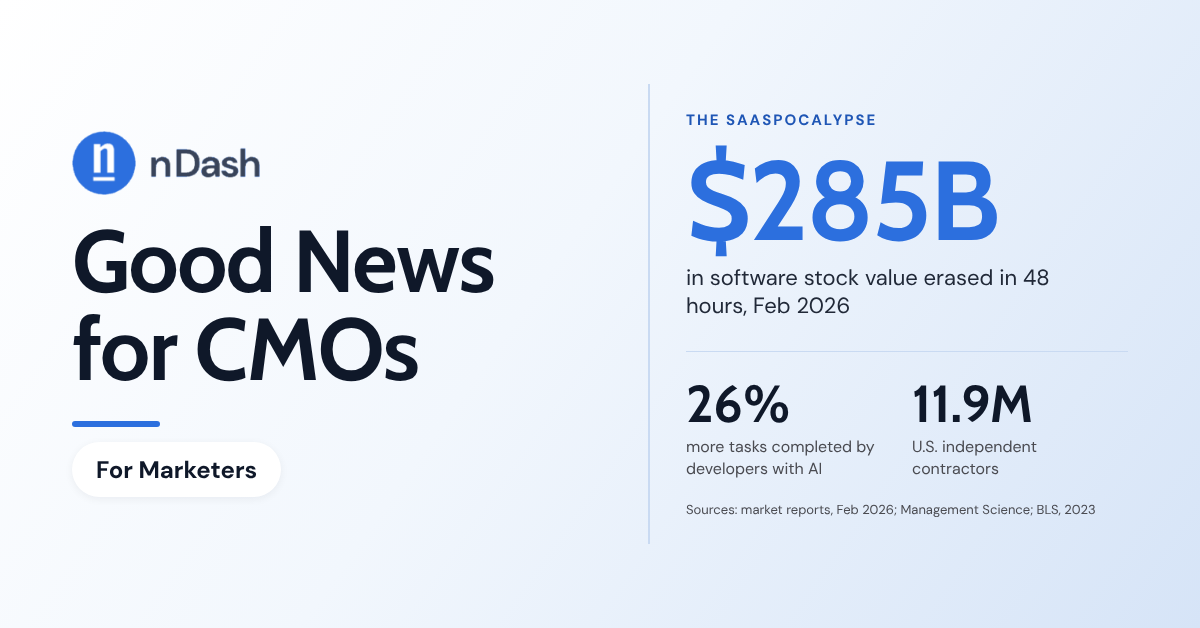
Still, his prediction is worth taking seriously because free, nearly identical versions of popular paid apps will keep appearing. The research backs up the trend. In randomized trials at Microsoft, Accenture, and a Fortune 100 company, researchers from MIT and Princeton found developers with an AI coding assistant completed about 26% more tasks. Less experienced developers gained the most. That study used code completion tools, which are already a generation behind today’s agents.
Wall Street also noticed. In early February 2026, investors sold off software stocks so hard that traders nicknamed it the SaaSpocalypse. They worried companies would need less software. Many were already trimming their software vendors, using AI coding tools to do the same work faster, and buying fewer licenses. That pressure is now pushing vendors away from per-seat pricing.
In just 48 hours, software companies lost about $285 billion in market value. Some analysts estimate that losses over those two months came closer to $2 trillion. Although prices have partly rebounded since then, the sell-off showed how quickly investors will reprice software once AI changes what it costs to build.
The takeaway: Code is getting cheaper to write, so software is getting cheaper to buy. Pricing power is shifting from the tools to whoever uses them well.
What Do Consultants Say About AI and SaaS Pricing?
Generative AI and AI agents are already disrupting SaaS by automating tasks and replicating workflows. Over time, that could shrink software spending or replace parts of it outright. The shift is also changing how software gets priced. When an AI agent does work a person used to do, customers are likely to expect to pay for results rather than logins. Developers using generative AI can also write new code in about 40% less time, so software-building costs keep falling.
That said, AI could also turn some labor spending into software spending. As agents take over coordination work like routing, reporting, and data entry, that shift could create an estimated $100 billion US market. Creative work that depends on judgment, voice, and audience trust is a different story. That’s where your budget still goes the furthest.
Why Should Marketing Leaders Care About the SaaSpocalypse?
If you run a marketing team, you probably don’t care how Photoshop gets built. You do care about where your budget goes.
For years, marketing teams have accumulated subscriptions for everything from planning and creating briefs to managing approvals and paying freelancers. Each one charged a monthly fee, no matter how often you used it. With AI making software cheaper to develop, paying a premium for the platform itself is harder to justify.
Meanwhile, the talent you’d move that budget toward is already out there and used to working flexibly. In July 2023, the most recent government count, 11.9 million Americans worked as independent contractors, consultants, or freelancers. That’s about 1.3 million more than in 2017. Remote work has stuck, too. In June 2026, nearly half of workers in information and 42% in professional and business services teleworked.
AI has made many business processes more efficient and less expensive, including those in marketing. Good judgment, however, still comes at a price. You still need people who understand your buyers and can explain complexities to a skeptical CISO. You also need designers who keep every asset on brand and aren’t afraid to make creative choices. Because that expertise is harder to replace than any tool in your stack, it deserves a bigger share of your budget.
The growing availability of inexpensive software should influence how marketing teams plan for 2027. It’s worth examining whether subscription costs are consuming funds that could support better talent.
How Should CMOs Respond to Cheaper Software?
You don’t need to rip out your stack, but now is a good time to rethink where your marketing dollars go. The following steps can help you cut what you’re overspending on software and put the savings toward the people and work that drive results:
- Audit every subscription: List each tool, its costs per seat, and who actually uses it. Then, cancel anything that overlaps with another tool or goes unused.
- Renegotiate at renewal: Software development is getting cheaper, putting pressure on vendors to offer more competitive pricing. Use that leverage to negotiate price negotiations during renewals.
- Switch to pay-for-what-you-use pricing: Where you can, replace flat subscriptions with tools that charge only when they’re used. That keeps your budget flexible as your needs change.
- Reinvest the savings in work that drives pipeline: Put the money into demand gen content, SEO and AI search visibility, paid campaigns, and sales enablement. Track each dollar against the pipeline and revenue it produces.
- Hand trust-building work to experienced people: Delegate thought leadership, brand voice, and customer-facing copy to freelance talent who know your market.
- Build a flexible bench of talent: Line up freelance and fractional talent you can scale up for a launch and back down afterward. That way, you avoid adding headcount or signing long contracts.
👉See how flexible budgets help teams redirect spend when priorities shift: How Flexible Marketing Budgets Reduce Operational Friction
We’ve Been Saying This for Years
This isn’t a new position for us. It’s been on our website for a long time, in a few different forms:
- Our pricing page used to read: “Put your budget towards content (not software).”
- When we expanded beyond writers, it became: Put your budget “towards talent (not features).”
- Our content services page still notes that we don’t charge for “software licenses” and that your budget goes toward the work itself.
We built nDash on the belief that the platform should be the cheap part. Vetted freelancers, careful matching, and hands-on support produce great work, and our software has always delivered it.
👉 Learn how nDash grew from a writer marketplace into a multi-discipline talent platform: The Next Chapter of nDash (and Why It Took Us 10 Years to Get Here)
Putting Our Money Where Our Mouth Is: nDash Pro Is Now Free
Saying software should be cheap is easy. So we went further. As of our October 2026 Release Notes, nDash Pro no longer requires a subscription. Here’s how it works as of October 2026, per our pricing page:
- Free to start: Add a payment method, and you’re only charged when you approve completed work.
- Everything you need to hire: Pro includes hands-on account setup, talent sourcing and vetting, unlimited users, and all platform features.
- Optional upgrade: A $300-per-year add-on unlocks lower platform fees, longer approval windows, off-network recruiting, priority talent matching, and consolidated monthly invoicing.
- Bring your own freelancers: Already have people you trust? You can bring them onto nDash on every plan.
And if you’d rather not manage freelancers at all, our Managed plan gives you a dedicated project manager who runs your freelance team for you. Same talent, run at your instruction.
Frequently Asked Questions About the SaaSpocalypse and nDash Pro
What Is the SaaSpocalypse?
The SaaSpocalypse is the nickname traders gave to the sharp sell-off in software stocks in early 2026. Investors bet that AI coding tools and agents would make software cheaper to build and weaken per-seat pricing. About $285 billion in software market value disappeared in 48 hours in early February 2026.
What Is ArtCraft?
ArtCraft is a set of free, open-source alternatives to seven Adobe apps, including Photoshop, Premiere, and Lightroom. Engineer Brandon Thomas built them with Claude Opus 5.5 and Rust. As of October 2026, the apps are in early alpha.
Is nDash Pro Really Free?
nDash Pro has been free since October 2026, when we stopped charging a subscription. Instead, you add a payment method when you sign up and pay only for the work you approve. Your account still comes with full access to the platform and unlimited users. Our team will also help you get set up and find vetted freelancers.
What Does the $300 nDash Pro Add-On Include?
The optional $300-per-year add-on lowers your platform fees and gives you longer approval windows. It also adds off-network recruiting, priority talent matching, and consolidated monthly invoicing.
Can I Bring My Own Freelancers to nDash?
Yes. You can bring freelancers you already work with onto nDash on every plan, and nDash handles their payments.
Put More of Your Budget Behind Talent
AI will keep pushing software prices down. That’s good news for marketing teams, as long as the savings go somewhere they can make a difference. We think that’s creative people who know your audience and your brand.
We’ve believed in the power of talented people since day one. Now our pricing puts even more of your budget behind them.
Start free on nDash or talk to our team about a managed freelance team.