

It’s stressful to let go of projects and trust someone else with them. I completely understand that part of a new engagement. A managed marketing engagement starts long before anyone receives an assignment. The question is, how do you scope that first engagement? I’ve outlined some questions below to help you figure that out.
A managed marketing engagement combines external marketing talent with an agreed level of project management. Scoping one means defining the business need, deliverables, responsibilities, budget, timeline, reviews, reporting, and kickoff requirements before production begins.
TL;DR: What Should You Define Before a Managed Marketing Engagement?
Define these areas before a managed marketing engagement moves into production:
- Start with the business need, audience, desired result, success criteria, and any restrictions affecting the engagement.
- Define each deliverable in enough detail to identify the required research, specialties, technical support, and final format.
- Decide how much of the project the provider will manage and which responsibilities your internal team will retain.
- Build a budget that covers all aspects of the managed marketing engagement.
- Structure the timeline around production stages, review windows, approvals, and the order in which freelancers enter the project.
- Establish how feedback, acceptance criteria, and reporting will work before production begins.
- Use kickoff to confirm contacts, systems, access, materials, dates, availability, and the first projects moving into production.
What Business Need Should a Managed Marketing Engagement Address?
A managed marketing engagement should address a specific business problem, audience, and business result before production planning begins. Your marketing engagement objectives establish why you need outside support before the conversation turns to production. Start with the business problem the engagement needs to address. Then connect that need to a specific audience and business result.
For example, a team supporting a new service launch has different marketing project requirements than one expanding organic search visibility. Sales enablement creates another set of needs because the content must support a different part of the buyer journey. Naming the business problem keeps the engagement tied to a defined marketing priority.
Who Should the Managed Marketing Engagement Reach?
Identify who the project needs to reach and what you want that audience to do after engaging with the content. Technical buyers often need different subject expertise, source material, and depth than executive decision-makers. Those audience requirements help a provider understand the level of expertise the engagement demands.
Connect the project scope to your overarching marketing strategy. Linking it to a product launch, search initiative, demand generation campaign, or specific promotional push highlights the effort’s strategic value. It also gives the provider full flexibility in structuring and managing their team.
How Should You Define Success Criteria and Boundaries?
Success criteria connect the engagement to measurable business results. Boundaries document the restrictions that affect how the project can be completed. Prioritize KPIs that directly support your objectives. Examples include organic traffic, conversion rates, resource library downloads, qualified leads, or sales pipeline impact. You and your team are trying to answer several questions before starting a managed engagement, including:
- What business problem does the engagement address?
- Who does the project need to reach?
- What business result does the project support?
- Where does it fit within the current marketing plan?
- Which evidence will show whether it succeeded?
- Which restrictions shape the engagement?
Those answers create a foundation for the rest of the scope. A managed service provider can now understand what you’re trying to accomplish without guessing from an asset request. The next step is translating that foundation into specific deliverables.
Turn Your Answers Into a Scope Statement
Use the answers above to create a short statement you can share with a managed marketing provider:
We need [assets] for [audience] to support [campaign or business result]. The engagement must account for [requirements or restrictions], and we’ll measure success using [KPIs].
That statement gives the provider a starting point before the conversation turns to deliverables, staffing, and production.
Which Marketing Project Deliverables and Disciplines Do You Need?
Your deliverables determine which specialties, inputs, technical requirements, and final formats the engagement needs. A label such as “blog post” or “landing page” tells a provider very little about the production involved. Break each deliverable into enough detail to reveal the required specialties, inputs, and final format.
What Should Project Deliverables Include?
Each deliverable should identify its content type, quantity, destination, research inputs, production criteria, technical requirements, required specialties, and delivery format. Capture the following information before a provider builds the proposed team:
- Content type and quantity: For example, six articles, one gated guide, or one landing page.
- Format and destination: Such as Google Docs, a CMS, a designed PDF, or a live webpage.
- Research inputs: Ask the team to identify what keyword research, SME interviews, original research, or existing source materials are required.
- Production criteria: Specify the end-to-end support needed and related requirements.
- Technical requirements: Define whether the project needs technical support and which tasks it should cover.
- Required specialties: Identify the mix of expertise needed to produce the deliverables, such as writing, editing, design, development, or SEO.
- Delivery format: Define exactly what the provider hands back when production ends.
Those fields expose requirements that an asset count can hide. Six SEO articles with interviews and CMS preparation require a different team than six articles based on supplied research. A gated guide that requires original research and design also calls for more than just a writer.
What Can a Managed Marketing Engagement Include?
Consider a three-month campaign to support the launch of a new B2B service. The internal team needs educational content, a gated asset, a landing page, and social promotion. Its marketing project deliverables could include:
- Six SEO blog posts requiring keyword research, SME interviews, writing, editing, and publishing preparation.
- One gated guide requiring research, writing, editing, design, and final PDF production.
- One landing page requiring copywriting, design, development, testing, and launch preparation.
- Twelve LinkedIn posts adapted from approved campaign messaging and assets.
- Monthly performance summaries based on the metrics selected during scoping.
Define your deliverables before building the team so you know which skills and roles the project requires. The engagement needs SEO expertise, writers, editors, designers, development support, and project management. A provider can now propose freelance talent based on actual production requirements, rather than a vague request for more content.
Check the Full Production Requirements
Before finalizing a deliverable, identify every step required to move it from the initial request to the finished asset. For example, at nDash, clients often begin with the deliverable itself before defining some of the requirements around it. Details such as length, SME input, outline development, and timeline expectations can change who works on the project and how production is structured.
Which Responsibilities Belong to Each Team?
How much each team owns depends on the level of management support your internal team needs. Some engagements include internal stakeholder tracking. Others cover only the provider and its freelancers.
Start by identifying which parts of the engagement you want the provider to manage. That decision determines how far project tracking extends across the people involved. It also helps establish what your internal team will continue handling independently.
A broader engagement can include tracking actions across your team, the provider, and each freelancer working on the project. The project manager can follow internal reviews, required source materials, SME interviews, freelancer assignments, approvals, and other scheduled actions. Your internal stakeholders still complete their assigned tasks, but the provider tracks them alongside the rest of the project.
Another team may need less support. Your team can manage its own stakeholders, approvals, and internal activities while the provider tracks its staff and freelancers. The provider still manages the production stages under its control without overseeing every internal action.
Decide How Far Provider Management Should Extend
Decide which description best matches the engagement:
- Provider-managed production: Your team handles internal stakeholders and approvals. The provider manages its freelancers and the production stages it controls.
- Broader project management: The provider also tracks internal reviews, source materials, SME access, approvals, and other actions that affect production.
For example, clients on nDash’s Managed plan often ask us to manage daily production, including freelancer assignments, deadlines, revisions, handoffs, and delivery. Their internal teams typically retain strategy, brand decisions, stakeholder approvals, and final approval.
Once you’ve defined the level of support, document who’s involved and what each person needs to complete. Responsibility changes as an asset moves through production. For example, once the writer completes approved revisions, their role ends, and the asset moves to design. Project tracking should show who’s actively responsible at each stage, so you’ll know who to go to if things stall.
👉 Related reading: Explore the freelance roles nDash can bring together when a managed engagement requires support across multiple specialties. Click here to learn more: The Next Chapter of nDash (and Why It Took Us 10 Years to Get Here).
What Should Your Marketing Project Budget Include?
Your budget should cover the full managed marketing engagement, including production and required support. Asset prices account for only part of the total cost.
Sometimes, clients budget for the assets first and account for project management later. On nDash’s Managed plan, that work can include freelancer selection and onboarding, kickoff, assignment tracking, stakeholder feedback, and deadline management. Those activities need their own place in the budget rather than being treated as part of the per-asset price.
nDash offers three plans. Pro is a free, self-serve marketplace where you find and manage freelancers yourself, with an optional $300/year add-on for lower fees and longer approval windows. Managed is custom-quoted: a dedicated project manager runs your freelance team on the nDash platform from scoping through delivery. White Label is also custom-quoted and integrates the nDash platform into your own business.
Remember that costs depend on the mix of expertise required. For example, a blog may only need writers and editors. A campaign, by contrast, may require additional support from designers, developers, or webinar moderators.
The scope should also explain how requests outside the approved engagement are priced. Added assets, extra revision rounds, or newly requested specialist support will trigger a documented change.
Before approving the budget, check for costs that sit outside the price of the deliverables themselves:
- Who will select and onboard the freelancers?
- Does the project require research or SME interviews before production starts?
- How much project management and meeting time will the engagement require?
- How many revision rounds are included?
- Will any deliverables need editing, design, development, or other specialist support?
- Does the engagement include performance reporting?
- How will added deliverables, extra revisions, or other requests outside the approved scope be priced?
👉 Related reading: See how flexible marketing budgets help teams account for changing project needs without rebuilding the entire plan. Check it out: How Flexible Marketing Budgets Reduce Operational Friction – nDash.com.
What Should Your Marketing Project Timeline Include?
Build the marketing project timeline after you know what each deliverable requires. Start with the final delivery date and work backward through production. Give each stage a start date, completion date, and any review or approval time required before the next stage can begin.
A gated asset, for example, might move through this sequence:
SEO research → Gathering resources → Brief development → SME interview → Writing → Editorial review → Copy approval → Design → Design approval → Final production
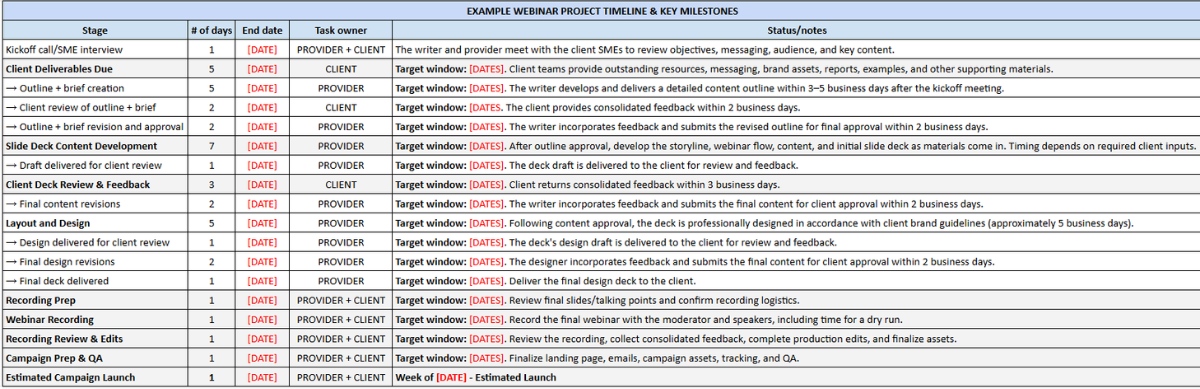
The dates need to reflect how each stage connects. Also account for the time between production stages. If stakeholders have three business days to review copy, add that time to the timeline. When a date moves, look at what comes after it before changing the rest of the schedule. Update the stages that are actually affected and let the people assigned to those dates know what moved.
The finished timeline should show how long each deliverable takes from its first production step through final delivery. It should also make it easy to see which date controls what happens next. Here’s an example of what that might look like:
How Should Reviews, Approvals, and Reporting Work?
Define how feedback moves through the project, what counts as a revision, when a deliverable receives approval, and how performance reporting works.
How Should Marketing Feedback Be Collected?
Choose one place for reviewers to leave comments, and decide who will consolidate them before sending them back to the freelancer. Feedback coming through separate documents, emails, or messages can create conflicting directions. The freelancer should receive one approved set of revisions to work from.
How Should Revision Rounds Be Managed?
Set the number of revision rounds included in the engagement and define what those rounds cover. Requested changes to submitted copy can stay within the revision process. Evaluate feedback that introduces a new direction after approval against the original scope. The provider can then decide whether to include the request, charge extra, or change the scope.
What Should Project Acceptance Criteria Include?
Project acceptance and approval criteria define when a stage or deliverable is complete. Those requirements change from project to project. For example, an article requires approved copy, verified links, correct metadata, and final formatting before acceptance. A landing page needs functioning forms, working links, approved creative, and testing.
What Should Marketing Reporting Include?
Define what you want to see in each report and how often you need it. The metrics should come from the success criteria you established earlier. Also decide who will review the results. That person should know what they’re looking for and what they’ll do with the information afterward.
What Should Be Defined Before Kickoff?
| Define During Scoping | Confirm During Kickoff |
| Business objectives | Named freelancers and contacts |
| Deliverables | Project and communication systems |
| Team responsibilities | Required access and materials |
| Pricing | Milestone dates and availability |
| Production timeline | Immediate first actions |
| Review and approval rules | Owners and due dates for outstanding items |
Kickoff should put the approved scope into motion. It shouldn’t reopen decisions that both teams already settled during scoping.
What Should a Marketing Project Kickoff Confirm?
A marketing project kickoff should confirm the operating details required to start production. Objectives, deliverables, responsibilities, pricing, timing, and approval rules should already be settled. Use the meeting to confirm the people, delivery dates, and actions needed for launch.
The kickoff should cover the following:
- Team introductions and contacts confirming freelancers, internal stakeholders, project management contacts, reviewers, and approval contacts.
- Communication and project systems confirming where assignments, files, project questions, and status updates will live.
- Required access and materials confirming brand files, research, templates, product information, analytics access, and CMS permissions.
- Dates and availability confirming milestone dates, planned stakeholder absences, interviews, and review windows.
- Immediate first actions to confirm which project starts first, who starts it, which materials are ready, and what your team will provide next.
Anything that isn’t ready at kickoff should leave the meeting with an owner and due date.
How Do You Evaluate a Provider for a Managed Marketing Engagement?
Send your marketing project scope before the first serious conversation with a provider, whenever possible. The provider should be able to respond with a proposed team, pricing approach, schedule, and questions about genuine gaps. Their response gives you a useful way to judge whether they understand the engagement you defined.
Pay attention to the questions a provider asks before recommending freelance talent. Those questions should show they understand what you’re asking them to manage. If they jump straight to staffing, they’re probably working from the deliverables instead of the full scope.
We’ve expanded the freelance roles available on nDash beyond writing and editing, and our Managed plan can bring them together into a single engagement. See how those new roles can support the mix of specialties you identified while scoping your project. Read more about these exciting changes here: nDash Expands Platform with New Roles Across Its 500K+ Freelance Network, Managing Fractional Marketing Teams End to End.
Frequently Asked Questions About a Managed Marketing Engagement
What Should a Managed Marketing Engagement Include?
A managed marketing engagement should include defined objectives, deliverables, responsibilities, budget, timeline, reviews, approvals, and reporting requirements. The scope should also identify the specialties and support required to complete each deliverable.
How Do You Scope a Managed Marketing Engagement?
Scoping a managed marketing engagement starts with the business need and the result the project needs to support. Then define the deliverables, production requirements, responsibilities, budget, timeline, review process, and approval requirements before production begins.
How Much of an Engagement Should a Provider Manage?
A provider should manage the parts of the engagement where your internal team needs support. That can include the full production process or only the provider’s staff and freelancers. Define that level of support before assigning individual responsibilities.