
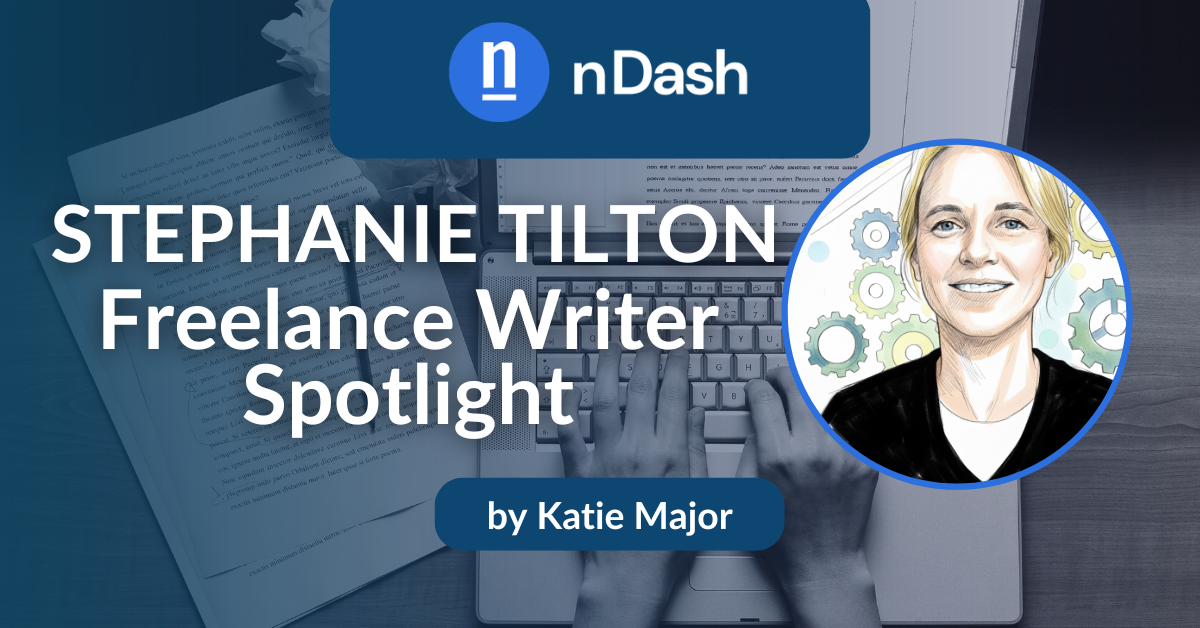
At nDash, we’re incredibly lucky to have a well-rounded roster of excellent freelance writers on our platform. We caught up for a chat with one of our newest members, Stephanie Tilton of Ten Ton Marketing.
Background: The Highlights
Stephanie is down-to-earth, a warm ray of sunshine, and a pleasure to talk to. She brings more than two decades of experience in B2B tech, with a special focus on brand-forward top- and middle-of-funnel content.
Allergic to boring, robotic writing, she translates complex technical jargon into compelling narratives that resonate with busy decision-makers.
Stephanie has written for brands including Akamai, LinkedIn, Marketo, People.ai, and PTC. She helps them turn sophisticated products into narratives that attract the right audiences and support real buying decisions.
She surmises it well, saying, “Basically, if it involves complex tech and needs a narrative that actually moves the needle, you’ll find me there.”
In our chat, Stephanie shares her thoughts on her airtight writing process, what she considers a truly effective piece of content in 2026, and tells us about the guide she created that generated over a million downloads on LinkedIn.
Ten Ton Marketing, An Inception
Most freelance writers know this path well: the accidental landing into the world of copywriting. When we laughingly discuss how niche and specific most freelance writing careers start, she says, “You can’t follow this path…it finds you.”
Stephanie started in marcom and later moved into product marketing and competitive intelligence. While at Akamai Technologies, she noticed that product marketers on her team would practically hide when it came time to write content.
They’d say, ‘Hey, you actually like writing…can you take this over?’ That was Stephanie’s accidental landing. Her lightbulb moment. She realized she could translate complex industry messaging and product capabilities into stories that people on the other side of the screen would enjoy reading. She eventually broke away to start her own consultancy, and Ten Ton Marketing was born.
nDash’s Discussion with Stephanie Tilton
Katie: What is your favorite aspect of writing for brands in B2B tech?
Stephanie: There’s a reason you see so many articles titled “B2B doesn’t have to be boring.” It is boring when it’s just features and benefits. I love helping companies move beyond the “bits and bytes” to show what the tech actually makes possible.
I’ve long said that before you can be the vendor of choice, you have to be the voice of choice. Buyers are hungry for a partner they can actually trust. They want you to inspire them with an attainable vision and then prove it with a human-centric case study that doesn’t put them to sleep.
Katie: How would you describe your writing style or approach?
Stephanie: I’m a firm believer in doing my homework before I write a single word. I like to let the asset strategy, topic, and buyer insights marinate for a bit alongside the brand voice.
Think of it like slow-cooking a roast. Anyone who knows me will laugh at the analogy since the kitchen is not where I do my best work. But I do know that a slow-cooked roast beats a microwave dinner every time. Content that has had time to ‘simmer’ is far more effective.
By the time I sit down to draft, all those flavors have fully melded. The result is a ‘meaty’ asset that works overtime instead of just a collection of empty words.
Katie: What does your typical writing process look like from assignment to final draft?
Stephanie: For case studies, I start with a backgrounder filled out by my client’s internal account team. I research the customer’s market positioning before a kickoff call, where I align with my client on the story hiding beneath ARR graphs and usage spikes.
Then, I tailor my questions to each interview while leaving enough breathing room for a conversation. I never want it to feel like an interrogation, no bright lights or polygraph tests!
My goal is to make interviewees comfortable enough to open up and share the kind of authentic insights a rigid list of questions could never elicit. I then craft a narrative that resonates with lookalike buyers by giving them a transparent view of the process and the specific challenges my client helped my client overcome.
For long-form assets like eBooks and white papers, I’m a stickler for an outline. After digesting all the background and interviewing SMEs, I create a deep-dive outline that lets everyone see the flow early on.
It’s the best way to catch “Oh, we should have mentioned that” before I’ve written 3,000 words. Because of that alignment, my first drafts usually sail through reviews with minimal “Can we change this entire section?” feedback.
Katie: What do you think makes a piece of content truly effective for clients today?
Stephanie: In addition to being structured for AI-led discovery, it has to hit the sweet spot between where the client excels and the problem the customer is losing sleep over.
With that in mind, here are three things that differentiate effective content right now:
- Mining data gold: In a world of ‘trust me’ marketing, evidence-backed insights are the ultimate authority. Any vendor with proprietary data is sitting on a treasure trove. Backing visionary narratives with this data provides the hard proof that your proposed path delivers real ROI.
- Popping the hood: Buyers want to see your solution’s “engine” and a blueprint for making it work in their world. They value content that deconstructs the nuts and bolts of integrations and pulls back the curtain on the implementation process. Whether it’s a technical white paper or a granular case study, transparency is what instills the confidence buyers need to finally abandon the status quo.
- Fueling the full journey: The most meaningful part of the customer journey starts after the contract is signed. Creating resources that guide customers through the honeymoon phase and toward real results is a huge opportunity for account expansion. When content helps a customer solve their next big challenge and makes them look like a hero to their boss in the process, it builds the kind of loyalty that makes renewals a non-event.
Katie: Is there a project or piece you’ve worked on that you’re especially proud of? Why?
Stephanie: I helped write every edition of The Sophisticated Marketer’s Guide to LinkedIn. It was downloaded over a million times and generated millions in revenue for LinkedIn Marketing Solutions. Not bad for a “boring” B2B guide 😉!
I’m also proud of the Legends of Sales and Marketing program with People.ai. I distilled interviews with leaders at companies like Snowflake, Accenture, and Gong into human-centric profiles. It was a blast bringing those stories to life, giving readers a look at the backstories and personalities behind the massive success.
Katie: What are your thoughts on how things have changed for freelance writers over the last 3-5 years?
Stephanie: The “Drafting Robot” has entered the plot. As more companies use AI to churn out generic content, the premium on human strategy and insight has gone through the roof.
The best clients aren’t looking for someone to just “fill a page” anymore. They want a consultant who can drive consensus across a complex buying team, navigate evolving content best practices, and act as a trusted extension of the team.
If you’re just a “writer,” you’re in danger of being seen as a commodity. But if you’re a strategist who handles the heavy lifting, you’re an indispensable partner.
Katie: What’s one tool/resource that you can’t live without when writing?
Stephanie: Otter.ai or any transcription tool that saves me from frantically scribbling notes. I want to be fully present during interviews, listening for the subtext instead of just racing to capture every word.
Having a transcript lets me focus on the human connection in the moment, then go back later to find the pivotal quotes and nuances that bring a technical story to life.
Katie: How do you stay inspired or creatively energized as a writer?
Stephanie: I’m a voracious reader. I love tuning into the rhythm of other voices, whether it’s how a journalist hooks a reader in the first sentence or how a novelist builds tension. Seeing how other writers shift a mindset or trigger an emotion keeps me from falling into a formulaic trap with my own work.
I also stay sharp by telling stories outside of the B2B bubble. I recently wrote a piece for a mountain bike publication about Bob Hicks, a local legend. He helped build the New England Mountain Bike Association into a powerhouse and is still hitting the trails at 96.
Switching gears like that (pun fully intended!) keeps my perspective fresh and reminds me that even the most technical topics benefit from a little narrative soul.
Katie: What’s one piece of advice you’d give to newer freelance writers?
Stephanie: You’ve heard the saying “software is eating the world.” Now AI is eating software… and writing jobs along with it. My advice? Don’t just be “a writer.” That might sound strange coming from a writer, but it’s the only way to avoid being treated as if you’re easily replaceable.
Harness your brain and humanity for all they’re worth! Master at least one specialized area so you can’t be swapped out. Maybe you understand the psychological triggers of the modern buying group, or you’re a top-notch interviewer who can surface the hidden gems in every conversation.
When you provide a meaningful outcome rather than just a word count, you become a partner. You’ll know you’ve arrived when your clients treat you as part of their team and start including you on their strategic planning calls.
Katie: What are you currently working on or excited about next?
Stephanie: I’m really excited about a project that follows customers from the “I do” (contract signing) through the “renewal vows.” We’re building a content framework that ensures they don’t just buy the solution, but actually succeed with it and can easily socialize that win.
It’s a win-win-win: the client learns how to help their customer succeed, the customer sees adoption and ROI soar, and the internal champion gets the recognition they deserve.
Katie: What’s your favorite type of assignment to receive?
Stephanie: Anything with an interview. I am endlessly curious and love hearing people’s stories. Whether they’re sharing a vision of the future or telling me how they slayed a metaphorical dragon to get a project live, I’m here for it. Finding the human pulse inside a complex technical narrative is my favorite part of the job.
Working With Stephanie Is a No-Brainer for B2B Tech Teams
Few writers can replicate Stephanie’s background, experience, and long-standing presence in B2B tech writing. True talent in this niche, and the ability to marry scroll-friendly storytelling with the ability to distill complex topics into digestible copy, is incredibly hard to find.
For brands that are hungry for a friendly, trusted partner skilled with creating unboring, meaty content, Stephanie Tilton is your person. To have her write for your B2B brand, connect with her via her nDash profile, add her to your favorites, and send her a message!
About the Author

Katie Major is a versatile marketing professional with a passion for content creation and strategic storytelling. She’s the Founder at Major Marketing, where her clients range from home services to wedding venues. To learn more about Katie — and to have her write for your brand — be sure to check out her nDash profile page.